


Google faced legal action over claims that Gmail scanned users’ emails without proper consent, and the resulting settlement could mean real compensation for qualifying users. Understanding what a class action lawsuit is matters here because eligibility, payout amounts, and deadlines all depend on specific criteria tied to how Gmail was used. Anyone who had a Gmail account during the covered period may have a valid claim worth pursuing.
Sorting through legal paperwork and scattered information makes the process harder than it needs to be. Sparrow simplifies it by giving users a clear path to check eligibility and file before deadlines pass, making it easier than ever to join class action lawsuits.
Table of Contents
- What is the Gmail Class Action Lawsuit About?
- Who Was Eligible for the Gmail Class Action Lawsuit?
- Is the Gmail Class Action Lawsuit Still Accepting Claims?
- How to Check If You’re Eligible for a Settlement Payment
- Tips for Avoiding Missed Settlement Payments
- How Sparrow Helps You Track Lawsuit Settlements and Unclaimed Money
- Start Finding Money You May Be Owed with Sparrow
Summary
- Class action settlements routinely go unclaimed not because people are ineligible, but because discovery fails before action ever begins. The Rodriguez v. Google LLC case illustrates this pattern at scale: roughly 98 million users had their privacy violated through unauthorized data collection, yet the gap between who qualifies and who actually files a claim remains enormous. Eligibility alone does not produce a payout.
- The core allegation in Rodriguez v. Google LLC centers on a specific broken promise. Users disabled their Web & App Activity settings, expecting Google to stop collecting data from third-party apps. Google continued collecting that data anyway, using it to power targeted advertising across nearly a decade, spanning Android and non-Android devices from July 2016 through September 2024. A federal jury in the Northern District of California sided with plaintiffs and awarded $425 million in damages, finding the practice violated California privacy law.
- Eligibility for the Rodriguez settlement did not require users to prove their individual data was misused. The class was built around a documented, systemic failure: the opt-out setting was off, collection continued, and that pattern repeated across millions of accounts. No receipts, screenshots, or technical logs were required to qualify; only a personal U.S.-based Google or Gmail account with the Web & App Activity setting disabled at any point during the eligible period.
- A jury verdict does not automatically open a claims window. Following the September 2025 verdict, Google filed post-trial challenges almost immediately, and as of mid-2026, no claims administrator had opened a filing portal or published a distribution timeline for the primary case. A separate, smaller Gmail scanning settlement reached $8.5 million and moved through the full cycle of verdict, challenge, negotiation, and claims distribution, illustrating how long that sequence actually takes.
- Settlement money is rarely concentrated in one place or one case. Active claims windows, unclaimed state funds, price-match refunds, and airline compensation often overlap for the same person but are only recovered when someone searches all categories at the same time. Members who use consolidated tracking tools access an average of 14 settlements simultaneously and recover over $345 per year, a figure that reflects the cumulative value across claim types rather than any single large payout.
- The practical barrier between eligibility and collection is almost never legal complexity. It is the friction of monitoring court dockets, parsing filing deadlines across multiple portals, and completing paperwork before windows close quietly. When that friction goes unaddressed, eligible funds get absorbed back into state systems or distributed only among the small percentage of claimants who happened to act in time.
- Sparrow addresses this by scanning for new settlements weekly, matching no-proof-required cases to user profiles, and handling form completion and submission so that eligible claims do not expire before anyone acts on them.
What is the Gmail Class Action Lawsuit About?
The Gmail class action lawsuit, formally known as Rodriguez v. Google LLC, alleges that users turned off Web & App Activity settings because they genuinely believed Google would stop collecting data from third-party apps. Google kept collecting this data anyway and used it to power targeted advertising revenue for almost ten years.
“Google allegedly continued harvesting user data from third-party apps for nearly a decade — even after users explicitly disabled Web & App Activity settings.” — Rodriguez v. Google LLC
🚨 Warning: Simply toggling off Web & App Activity in your Google account settings may not have been enough to stop Google’s data collection practices during this period.
💡 Key Point: At the heart of Rodriguez v. Google LLC is a critical question of user consent — did Google honor its users’ privacy choices, or did it prioritize targeted advertising revenue over data privacy rights?
| Key Detail | What It Means |
|---|---|
| Case Name | Rodriguez v. Google LLC |
| Setting in Question | Web & App Activity toggle |
| Alleged Violation | Continued data collection after opt-out |
| Duration | Almost 10 years |
| Purpose of Data Use | Powering targeted advertising revenue |
What Google allegedly did with your data
According to Kiplinger, roughly 98 million users had their privacy violated through this data collection practice, spanning Android and non-Android devices from July 2016 through September 2024. This was the core privacy toggle that everyday Gmail users relied on to control their digital footprint, not a niche product or obscure feature.
The frustration users report is specific: you found the setting, toggled it off, and trusted the system. The system quietly ignored you. That gap between what a privacy control promises and what it actually delivers isn’t a technical failure. It’s a contract violation dressed up as a user interface.
How did a federal jury rule on the Gmail class action lawsuit?
A federal jury agreed. In September 2025, the Northern District of California sided with the plaintiffs and awarded a $425 million damages settlement, finding that Google’s practices violated California privacy law. The verdict confirms that Google failed to keep its privacy promises to users.
Most people read a headline, feel wronged, and move on because filing a claim sounds like a lot of work. Platforms like Sparrow fill this gap, helping users discover settlements they qualify for and file claims without the paperwork maze that deters most people.
How does the Gmail class action lawsuit compare to earlier Google cases?
Rodriguez v. Google LLC isn’t the only case in this space. An earlier lawsuit, Matera v. Google, addressed Google’s scanning of emails sent from non-Gmail accounts into Gmail inboxes for advertising and profiling. That case resulted in Google agreeing to stop the practice, with no monetary payout to class members. The contrast with the $425 million jury verdict in Rodriguez demonstrates how significantly the stakes have changed as courts scrutinize how platforms handle user data.
Knowing the lawsuit exists is only half the story; who qualifies to claim a share of that verdict is where most people get stuck.
Who Was Eligible for the Gmail Class Action Lawsuit?
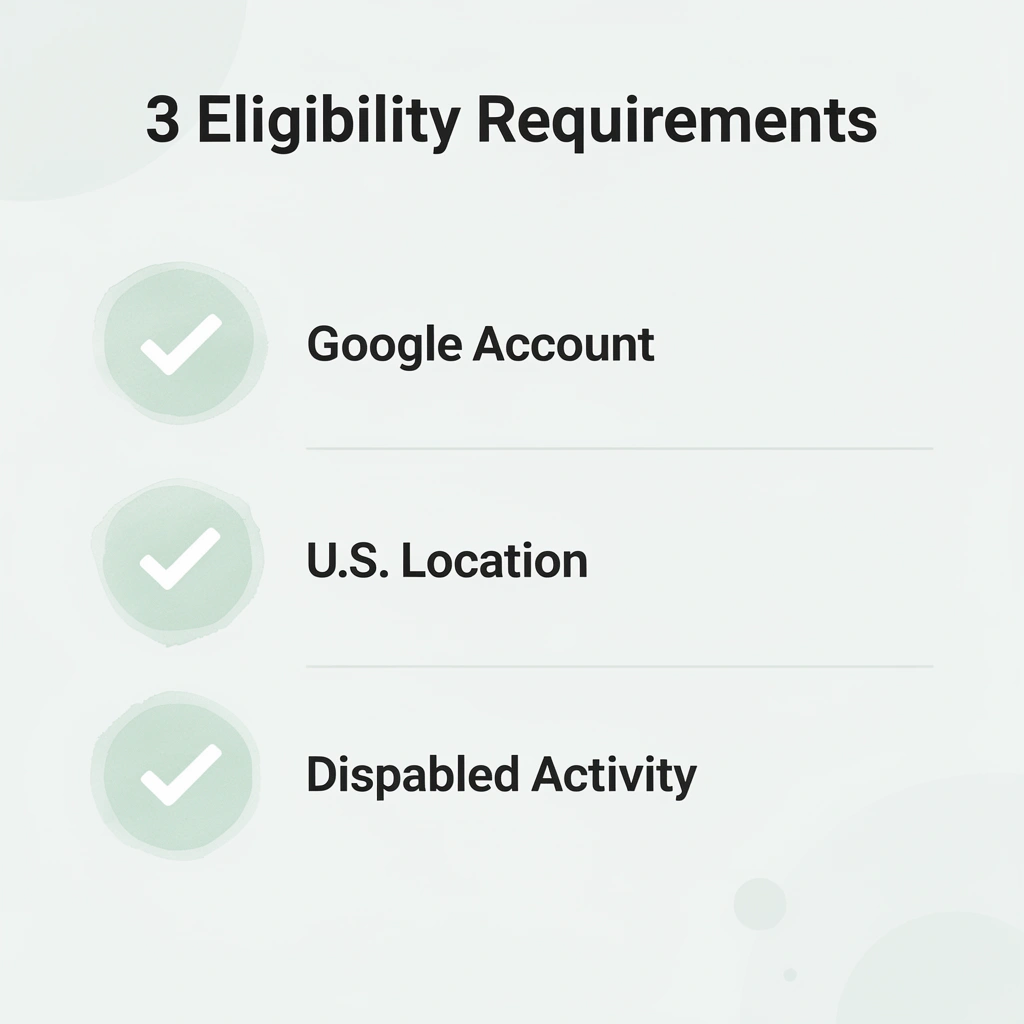
To be eligible for the Rodriguez settlement, you needed three things: a personal Google or Gmail account, a location in the U.S., and a disabled Web & App Activity setting between July 1, 2016, and September 23, 2024. If you turned that toggle off expecting Google to stop tracking you across third-party apps and it continued collecting data anyway, you were likely in the class.
“To qualify, users needed a personal Gmail account, U.S. residency, and a disabled Web & App Activity setting between July 1, 2016 and September 23, 2024.” — Rodriguez v. Google Settlement Terms
| Eligibility Requirement | Details |
|---|---|
| Account Type | Personal Google or Gmail account |
| Location | United States |
| Time Period | July 1, 2016 – September 23, 2024 |
| Key Action | Web & App Activity setting was disabled |
🎯 Key Point: You didn’t need to opt in or file a special claim to be part of the class — if you disabled Web & App Activity during the covered period, you were automatically included.
💡 Tip: Not sure if your setting was ever disabled? Check your Google Account Activity Controls history to verify your eligibility window.
98 million users had their privacy violated in this lawsuit. This was not a narrow technical violation affecting power users: it was a systematic failure that touched nearly every person who adjusted a privacy setting and assumed the platform respected it.
⚠️ Warning: Many affected users had no idea they were part of this class. Google’s continued data collection happened silently, even after users took deliberate steps to opt out.
🔑 Takeaway: With 98 million people impacted, the Rodriguez settlement stands as one of the largest consumer privacy cases in U.S. history. Privacy toggles must mean what they say.
Who specifically qualified?
The certified classes were divided into two groups: Android users whose data was sent via the Firebase SDK or the Google Mobile Ads SDK despite the opt-out setting being enabled, and iPhone users or non-Android users who experienced the same unauthorized collection through connected apps. Google Workspace accounts and supervised accounts for children under 13 were excluded. The target was the personal Gmail user who set up an account for everyday use and reasonably expected their privacy choices to be respected.
How do you find out if the Gmail class action lawsuit applies to you?
Most people who qualify have no idea they do. That gap between eligibility and awareness is where most settlement money goes unclaimed. Finding the right case, confirming the date range applies to your account, and filing before a deadline requires significant effort. Platforms like Sparrow address this friction point by surfacing settlements you qualify for and simplifying the filing process, so legitimate claims do not quietly expire.
What the opt-out failure actually means for your claim
The lawsuit did not require proof that Google used your specific data for a specific ad. Eligibility was based on the structural failure: the setting was off, collection continued, and this pattern repeated across millions of accounts.
How does the Gmail class action lawsuit define the eligible period?
The Federal Cellular Class Action records note that the eligible period spans from November 12, 2017, to the present, covering more than six years of repeated opt-out violations. You need no receipts, screenshots, or technical logs. Your claim rests on the platform’s documented, systemic practice, not on reconstructing your digital history.
Why is acting on the Gmail class action lawsuit time-sensitive?
The window to act on this is not permanent.
Related Reading
- What Is A Class Action Lawsuit
- What Is A Class Action Settlement
- How Do Class Action Settlements Work
- How To Find Unclaimed Money
- Are Class Action Settlements Taxable
- Doge Transparency FOIA Lawsuit
- Google Android Cellular Data Lawsuit
- Pima County Sheriff Lawsuit
- Ozempic Lawsuit
- General Motors V8 Engine Lawsuit
Is the Gmail Class Action Lawsuit Still Accepting Claims?
The Gmail class action claims window does not currently exist. The Rodriguez v. Google LLC verdict, delivered in September 2025, remains contested through post-trial motions, and as of mid-2026, no claims administrator has opened a filing portal or published a distribution timeline. Eligible users waiting for that portal lose time they cannot recover.
“As of mid-2026, no claims administrator has opened a filing portal or published a distribution timeline for the Rodriguez v. Google LLC case.”
⚠️ Warning: Do not assume a claims portal is open. No official filing window has been announced as of mid-2026. Submitting through unofficial third-party sites could jeopardize your eligibility.
💡 Tip: Bookmark the official court docket and check regularly. When a claims administrator publishes a distribution timeline, that becomes your window to act—and it may be narrow.

Why doesn’t a verdict immediately trigger the Gmail class action lawsuit claims process?
A jury verdict does not automatically start a claims process. Google’s legal team filed challenges after the $425.7 million verdict, and those motions must be resolved before any settlement fund can be organized or distributed. The Gemini AI tracking lawsuit illustrates this: it was dismissed in July 2026 for lacking sufficient detail about harm, forcing plaintiffs to revise their case and restart, despite the underlying privacy concern being nearly identical to that in the Gmail case.
What should you do while waiting for a Gmail class action lawsuit notice?
Most people search for “Gmail settlement claim form” and wait for a notice that never arrives, while cases actively accepting claims with no proof required and no complex verification steps go unnoticed. Platforms like Sparrow surface open settlements automatically, matching users to claims they already qualify for without requiring them to track court dockets or parse legal filings.
A separate case worth knowing about
According to ClassAction.org, the Gmail scanning class action settlement reached $8.5 million with a defined payout structure. That case moved through the full cycle: verdict, challenge, negotiation, settlement fund, and claims process. The Rodriguez matter remains in the first phase. Understanding where a case sits in that cycle determines whether you can file a real claim or must wait until a process not yet started begins.
What separates a live Gmail class action lawsuit claim from a pending one?
The critical difference between a live claim and a pending one is whether a claims administrator exists and a deadline has been published—not the verdict size. Neither condition is currently met for the primary Gmail privacy case. What does exist are other Google-related settlements with active windows, some of which are closing within weeks, covering overlapping groups of users who may not realize they qualify.
That gap between what users assume is available and what is open for claims is where most settlement money goes uncollected.
Related Reading
- Costco Sonoma County Lawsuit
- Apple Class Action Lawsuit
- At&t Class Action Lawsuit
- Temu Lawsuit
- Hexclad Lawsuit
- Nightfall Group Lawsuit
- Turbotax Lawsuit
- Amazon Prime FTC Settlement Lawsuit
- Isotonix Lawsuit
- Capital One Class Action Lawsuit
- Life360 Lawsuit
- Dapper Development Lawsuit
- Amazon Fire TV Stick Lawsuit
- Minnesota Ice Lawsuit
- Turbotax Lawsuit
How to Check If You’re Eligible for a Settlement Payment
Gmail users who are worried about privacy may qualify for compensation from legal cases against Google. Check if you qualify through official channels to avoid scams and understand your role in the cases that apply to you.
“Gmail users concerned about privacy should always verify eligibility through official channels — unofficial sources are a leading vector for settlement scams.” — Consumer Legal Advisory
💡 Tip: Before submitting any personal information, confirm the settlement portal is officially court-approved — look for a .gov or verified legal administrator domain.
⚠️ Warning: Never pay an upfront fee to claim a settlement. Legitimate compensation programs are always free to join.
| Step | Action | Why It Matters |
|---|---|---|
| 1 | Visit the official settlement website | Avoids fraudulent third-party sites |
| 2 | Confirm your Gmail account eligibility | Only qualifying users receive compensation |
| 3 | Submit your claim form through verified channels | Ensures your payment is processed correctly |
[IMAGE:

Start with Your Google Account History
Log into your Google Account settings and review the Web & App Activity section for July 2016 through September 2024. Check whether you turned off the toggle during that time while using third-party apps with Google SDKs. Personal Gmail accounts qualify under the Rodriguez case criteria, but Workspace and supervised child accounts do not.
Examine Device Usage Records
Check your Android or iOS device history for apps that used Firebase or Google Mobile Ads during the years in question. Compare this with Google Takeout exports of your account data to identify activity sent to Google servers. The Rodriguez classes cover smartphones on which data was sent to Google servers regardless of privacy settings, affecting approximately 98 million devices nationwide. This demonstrates your device was exposed and supports your eligibility.
Monitor Official Court and Case Updates
Visit the Northern District of California court website or search for Rodriguez v. Google LLC (Case No. 3:20-cv-04688-RS) dockets for post-verdict updates. As of July 2026, no claim administrator or form exists due to ongoing motions. Set calendar reminders for the August 2026 hearing to receive accurate notifications when the process begins.
Avoid Common Pitfalls and Scams
Ignore unsolicited emails or websites promising quick claim forms. Real processes come directly from court-approved administrators with verifiable websites. Official portals require identity verification and have strict deadlines (such as August 27, 2026, in the Assistant case). Verify every link through Google or court records to prevent fraud.
Take Proactive Privacy Steps Regardless of Eligibility
Export your data using Google Takeout, stop activity tracking, or check connected apps immediately. This limits further exposure regardless of the lawsuit’s outcome. Users affected by credential leaks benefit most from these protective habits.
Follow Up with Professional Resources
Talk to official government consumer protection websites or a trusted lawyer for a personalized review if your situation involves complex account usage. Court records and reputable news outlets provide the clearest path forward.
Tips for Avoiding Missed Settlement Payments
Missing a settlement payment usually happens because of missed deadlines, old contact information, or not knowing you qualify in the first place. Taking action ahead of time helps you stay consistently informed and reduce unclaimed money.
“The most common reasons claimants miss settlement payments are outdated contact details, expired deadlines, and a simple lack of awareness that they qualify at all.”
| Common Cause | Prevention Tip |
|---|---|
| Missed deadlines | Set calendar reminders for all claim dates |
| Old contact information | Keep your address and email always up to date |
| Not knowing you qualify | Regularly check for unclaimed money |
💡 Tip: Proactive monitoring is the single most effective habit you can build — don’t wait for a notice to come to you.
⚠️ Warning: Failing to update your contact information is one of the most overlooked reasons people miss out on payments they are fully entitled to receive.

Set Up Reliable Deadline Tracking Systems
Create a dedicated digital folder or spreadsheet for all potential settlements, noting key dates such as claim deadlines, fairness hearings, and payment distribution windows. Update entries when you find new information and set calendar reminders two weeks before deadlines, plus follow-up alerts. This prevents notices from getting lost in daily emails and mail, ensuring you take action on time even months after becoming eligible.
Maintain Comprehensive Purchase Records
Keep digital scans or photos of receipts, order confirmations, and credit card statements in one central, searchable location, organized by product category. Include purchase dates, amounts, and seller details: administrators need this verification for claims. Regular reviews of bank statements help you catch overlooked transactions and turn potential misses into successful filings.
Monitor Multiple Communication Channels
Check your physical mailbox, email spam folders, and online accounts weekly for notices from administrators. Sign up for alerts from consumer rights organizations or reliable platforms. Notifications arrive through multiple channels and can get lost in regular mail, causing valid claims to expire unnoticed.
Leverage Specialized Tools Like Sparrow for Streamlined Management
Sparrow scans new lawsuits and identifies class action lawsuits that don’t require proof. Users likely qualify based on their profile. Our service completes forms, handles printing and mailing with postage included, and guarantees your money back if you don’t recover at least the cost of your Sparrow subscription.
Review and Follow Up on Submitted Claims Regularly
After filing, save the confirmation numbers and check the status portals or contact the administrators every 30 days during the distribution phases. Respond promptly to requests for additional information to avoid processing delays. This follow-through ensures approved claims convert to actual payments, as pro-rata distributions depend on validated submissions reaching completion without administrative holds.
How Sparrow Helps You Track Lawsuit Settlements and Unclaimed Money
Information about settlements is spread across many different claim websites, court-approved sites, and state databases. Deadlines close with little notice while life continues. The problem is usually that people don’t find out about the settlement — not that they aren’t eligible. When a privacy violation affects millions of users, many eligible users learn they qualified after the deadline has passed. This happens not because they ignored the opportunity, but because no one told them about it in a way they could understand and act on.
“The problem is usually that people don’t find out about the settlement — not that they aren’t eligible.” — Key Insight
🚨 Warning: Settlement deadlines close without warning — by the time most people hear about a class action payout, the window to claim has shut.
💡 Tip: Sparrow monitors claims websites, court-approved databases, and state records so you never have to manually track whether you qualify — it does the heavy lifting for you.

| The Problem | Why It Happens | What’s at Stake |
|---|---|---|
| Settlements spread across many sites | No single centralized source exists | Eligible users miss valid claims |
| Deadlines close without notice | Court timelines don’t follow your schedule | Money left unclaimed permanently |
| Millions affected, few informed | Privacy violations reach a massive scale | Users lose rightful compensation |
🎯 Key Point: The gap between eligibility and awareness is where most unclaimed money disappears — and it’s a gap Sparrow is built to close.
How does Sparrow help you find and claim a Gmail class action lawsuit payout?
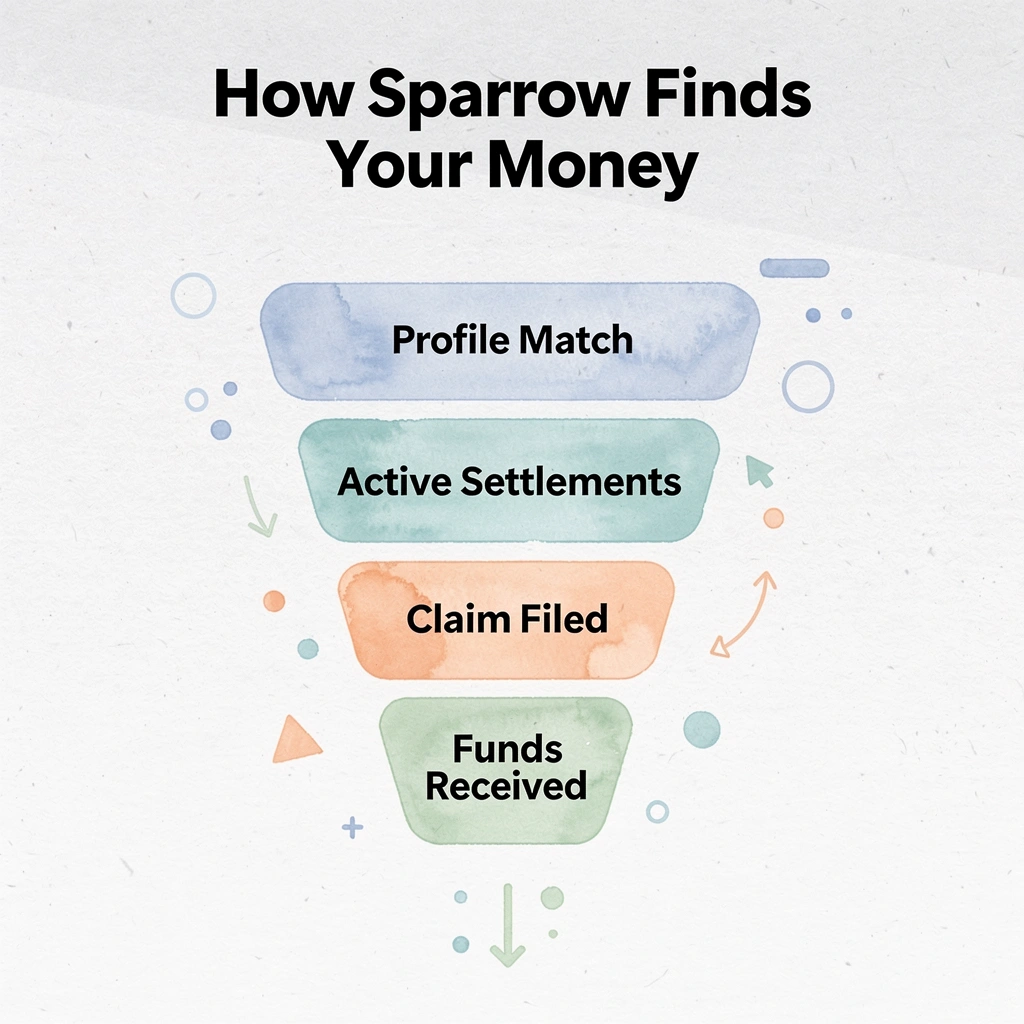
Sparrow was built to close that gap. Most people track settlements through periodic Google searches, bookmarked claim sites, and mental notes about deadlines that blur together. Sparrow scans for new settlements weekly, matches cases that don’t require proof to your profile, and delivers high-value opportunities to your inbox before deadlines arrive. It then fills in your claim forms, covers postage, and mails the completed paperwork on your behalf, compressing what took an afternoon into minutes.
The Sparrow AI Refund Helper tracks five distinct types of money sources: class action payouts, unclaimed funds, price-match refunds, airline compensation, and subscription credits. This breadth matters because money owed to you rarely lives in one place. Sparrow conducts nationwide searches across all categories under a single membership, with a live dashboard showing every active claim, its eligibility status, and its expected distribution timeline.
What does a Sparrow membership cost, and what can you expect to recover?
According to the Sparrow About Page, the $84-per-year membership includes a money-back guarantee: if you don’t recover more than you paid, Sparrow refunds the difference. Members access an average of 14 settlements simultaneously and earn over $345 per year.
The real change Sparrow creates is a shift in how you think: from passive and resigned to active and informed. The combined value across multiple claims, along with unclaimed money searches most people never consider, tells a different story.
If the barrier to claiming money you’re already owed is smaller than you assumed, what else have you been leaving on the table?
Related Reading
- Settlemate
- Truebill
- Is Settlemate Legit
- At&t Lawsuit
- Poppi Lawsuit
- Is Claimmoney.com Legit
- Rocket Money
- Catch
- Claim App
- Celsius Lawsuit
- Fortnite Lawsuit
Start Finding Money You May Be Owed with Sparrow
The money that belongs to you does not wait. Settlement windows close, unclaimed funds get absorbed back into state systems, and new lawsuits move forward whether or not you know they exist. Most people miss out not because they checked and came up empty, but because they never checked at all.
“Most people miss out on money that is legally theirs: not because they checked and came up empty, but because they never checked at all.“
⚠️ Warning: Settlement deadlines are permanent. Once a claim window closes, your eligibility disappears, and those funds are gone for good.

🎯 Key Point: Sparrow removes that barrier directly. Our platform is an all-in-one solution that handles every step of the process — so you never have to navigate the system alone.
| What Sparrow Does | Why It Matters |
|---|---|
| Identifies class action settlements you qualify for | No more missing claims you didn’t know existed |
| Helps you file claims | Removes the confusing paperwork barrier |
| Tracks your submissions | Stay informed on every claim’s status |
| Searches for unclaimed funds tied to your info | Uncovers money you may not know you’re owed |
💡 Tip: Most users are surprised to discover they qualify for multiple active settlements at once — the funds are already out there, waiting to be claimed.
Visit Sparrow today, see which active settlements and unclaimed funds match your profile, and start filing. The process is fast, free to start, and the result is simple: the money is already yours.
✅ Best Practice: Check your profile now before another settlement window closes.

Leave a Reply