


Receiving a notice in the mail about money owed from a lawsuit you never knew existed is more common than most people expect. Understanding what a class action lawsuit is and how settlements actually pay out helps people claim what they are owed without confusion or missed deadlines.
Sparrow simplifies the process by connecting people to open settlements where they may already qualify for compensation. Rather than sifting through legal notices or losing track of filing windows, users get a clear path to submitting claims and receiving their share of any approved settlement fund. Those ready to take action can join class action lawsuits through Sparrow and start finding claims that apply to them.
Table of Contents
- What Is a Class Action Settlement, and Who Is Eligible to Receive One?
- What Types of Cases Lead to Class Action Settlements?
- Can You Receive Money From More Than One Class Action Settlement?
- How the Class Action Settlement Process Works Step-by-Step
- How to Know If You Qualify for A Class Action Lawsuit Settlement
- How Sparrow Makes Claiming Class Action Settlements Easier
- Start Finding Money You May Be Owed with Sparrow
Summary
- Class action settlements resolve legal disputes between a group of people sharing the same grievance against a defendant. Courts review and approve the terms before any funds are distributed, ensuring the deal is fair for all class members, not just the named plaintiffs. Eligibility is determined entirely by the class definition set forth in the settlement agreement, which may specify a product purchase window, a data breach, or a set of employment conditions.
- Missing deadlines is the single biggest reason eligible people never receive compensation. Claim windows typically run just 60 to 90 days after settlement approval, and notices sent by mail or email are frequently ignored or missed entirely. Over 500,000 recipients have been paid through settlement distributions, confirming the system works when people actually engage with it.
- Corporate class action settlements reached $73.1 billion in 2025, surpassing all prior records and reflecting how frequently large-scale corporate conduct causes widespread consumer harm. Consumer fraud cases alone accounted for approximately 30% of all class action settlements in 2024, covering deceptive labeling, hidden fees, defective products, data breaches, and securities fraud. Antitrust violations in pharmaceuticals and technology markets add another layer, often affecting consumers who had no idea they were overcharged in the first place.
- Collecting from one settlement does not create a legal barrier to collecting from another. Under Rule 23 of the Federal Rules of Civil Procedure, a settlement release only extinguishes the specific claims litigated in that particular case. A consumer who qualifies for a data breach settlement and a product liability settlement involving different defendants can pursue both independently, and the FTC confirms that claimants regularly participate across multiple unrelated cases with no mechanism linking one payout to another.
- The practical obstacle is not eligibility but follow-through. Managing multiple simultaneous claims across different administrator websites, documentation requirements, and staggered deadlines is genuinely difficult to sustain manually. Most consumers abandon the process not because they lack entitlement but because the infrastructure required to track everything is fragmented and time-consuming.
- Documentation failures are the reason many valid claims are rejected without being corrected. Settlement administrators frequently require proof of purchase or transaction records that claimants no longer have, and submissions that fail to meet specific requirements are simply denied. Pre-submission verification against each settlement’s exact rules is what separates a successful claim from a quietly lost one.
- Sparrow addresses this by automatically matching users to active settlements, pre-filling claim forms, managing deadlines through a live dashboard, and providing real-time payout tracking so users know when distributions are expected rather than waiting and wondering.
What Is a Class Action Settlement, and Who Is Eligible to Receive One?
A class action settlement is an agreement reached when a group of people with the same legal problem against a defendant decide to accept money instead of going to trial. The court reviews and approves the terms to make sure the deal is fair and reasonable for all class members. Once approved, a settlement fund is set up and distributed to eligible members according to the terms.
“A class action settlement allows multiple plaintiffs with the same legal grievance to resolve their claims collectively — without the cost, risk, or delay of a full trial.” — Legal Industry Overview
💡 Example: If a company overcharged thousands of customers, those customers could form a class and collectively negotiate a settlement fund — rather than each person filing their own individual lawsuit.
⚠️ Warning: Not everyone automatically receives a payout. You must meet eligibility requirements and often submit a valid claim within a specified deadline to receive your share.
| Term | What It Means |
|---|---|
| Class Action | A lawsuit filed by a group of people with the same legal claim |
| Settlement | An agreed resolution that avoids going to trial |
| Settlement Fund | The pool of money set aside to pay eligible class members |
| Class Members | All individuals who qualify under the terms of the lawsuit |
| Court Approval | The judge’s confirmation that the deal is fair and legally sound |
🔑 Takeaway: A class action settlement is not just a legal formality — it’s a structured, court-approved process designed to deliver fair compensation to every eligible member of the group.
Who actually qualifies?
Eligibility comes down to the class definition, written into the settlement agreement and approved by the court. It specifies who belongs to the group: anyone who purchased a specific product during a set time window, anyone affected by a particular data breach, or employees who worked under certain conditions. If your situation matches those criteria, you are in the class, regardless of whether you received a notice. The notice is a courtesy. The class definition is the law.
What happens if you miss the claim deadline?
The main problem for most people is not that they don’t qualify, but that they don’t know about the settlement. Eligible people miss their chance because they never hear about it. The claim deadline—usually 60 to 90 days after settlement approval—passes without them submitting. According to Talli.ai, over 500,000 people have received settlement distributions, demonstrating that the system works when people participate.
What does the payout actually look like?
Most people expect a large check and are surprised by a modest one. According to analyses citing Consumer Financial Protection Bureau data, the average award to individual class members in some consumer settlements is around $32. While total relief reaches millions of dollars, individual amounts often remain modest after distribution. Check your notice for the estimated share in your case.
Payouts depend on the total fund size, the number of valid claims filed, and the harm each claimant can demonstrate. Settlements involving documented financial losses often tier payouts, providing more money to claimants who submit proof of specific expenses. Basic claims without documentation typically yield smaller, flat amounts.
How do class action settlements work when it comes to actually receiving your money?
Most consumers wait for a check to arrive or an email notification to land in their inbox. This approach has real costs: plain envelopes from unfamiliar settlement administrators get discarded, emails go to spam, and deadlines pass unnoticed. Platforms like Sparrow solve this by matching you to open settlements you qualify for, with pre-filled forms that reduce the process to minutes rather than hours of research and paperwork.
Once you understand who qualifies and how payouts are calculated, the next question most people ask is surprisingly specific: what kinds of corporate behavior trigger these settlements?
What Types of Cases Lead to Class Action Settlements?
Corporate misconduct rarely targets one person—it scales. A billing algorithm overcharges millions simultaneously. A data system fails to protect thousands of records at once. A manufacturer ships a defective product across an entire market. This structural reality—one decision creating harm at scale—makes class action settlements possible and increasingly enormous.
“Corporate misconduct rarely targets one person—it scales. One decision, one algorithm, one defective product creates harm at scale across millions of consumers simultaneously.”
🎯 Key Point: The defining feature of a class action case is systemic harm: a single corporate decision that damages thousands or millions of people at once, making individual lawsuits impractical and collective action essential.

According to Law.com / Corp Counsel, corporate class action settlements reached $73.1 billion in 2025, surpassing every prior record. This is a primary mechanism through which consumers get money back from companies that caused widespread, systematic harm.
💡 Tip: If you’ve been affected by a data breach, a defective product, or deceptive billing practices, a class action settlement may already exist—and you could be entitled to compensation without ever stepping into a courtroom.
🔑 Takeaway: $73.1 billion in a single year signals that class action litigation is not a niche legal tool—it is one of the most powerful financial accountability mechanisms available to everyday consumers today.
| Case Type | Common Example | Who Is Harmed |
|---|---|---|
| Data Breach | Exposed personal records | Thousands of account holders |
| Defective Products | Faulty household goods | The entire market of buyers |
| Deceptive Billing | Overcharging algorithms | Millions of customers |
| Securities Fraud | Misleading investors | Shareholders at scale |
The categories that generate the most settlements
Consumer fraud drives approximately 30% of all class action settlements in 2024, according to the Duane Morris Class Action Review 2025, which covers issues ranging from deceptive food labeling to hidden subscription fees. Product liability follows closely, with defective vehicles, electronics, and medical devices generating billions in damages when manufacturers cut corners on safety testing or conceal known risks. Securities fraud rounds out the top tier, targeting companies that misled investors by inflating earnings reports or concealing liabilities.
Which industries see the most class action settlements?
Employment cases affect entire industries through wage theft, unpaid overtime, and worker misclassification. When a company routinely denies overtime pay to hundreds or thousands of workers, the identical harm across the class is what courts seek to certify. Data breach settlements operate similarly: a single security failure affects millions of accounts, and the shared injury entitles every affected person to compensation.
How do class action settlements work when consumers don’t know they qualify?
Most people never connect everyday frustrations—unexplained utility charges, underperforming products, privacy notices buried in breach notifications—to class actions. These surface symptoms often stem from conduct that has already triggered litigation. Consumers miss settlements not because of ineligibility but because they are unaware of the case’s existence. Platforms like Sparrow address this by matching consumers to open settlements they qualify for, eliminating the research burden that causes most people to miss claims.
What role do antitrust violations play in class action settlements?
Antitrust violations add a rarely discussed layer to consumer harm. Price-fixing schemes in pharmaceuticals, technology licensing, and commodity markets inflate consumer prices without awareness. Victims often don’t realize they overpaid because manipulation occurred upstream between corporations before prices reached them. Settlements return a portion of that overcharge, sometimes years after the original harm.
Qualifying for multiple settlements at once is more common than most people realize.
Related Reading
- What Is A Class Action Settlement
- How To Find Unclaimed Money
- Doge Transparency FOIA Lawsuit
- General Motors V8 Engine Lawsuit
- Are Class Action Settlements Taxable
- Pima County Sheriff Lawsuit
- Google Android Cellular Data Lawsuit
- Shannon Sharpe Lawsuit
- Ozempic Lawsuit
Can You Receive Money From More Than One Class Action Settlement?
It is common to qualify for multiple settlements at the same time, and the legal system explicitly allows it. Each class action lawsuit has its own facts, class definition, and approved resolution: your eligibility is evaluated entirely independently for each case. Courts do not cross-reference your prior payouts when evaluating eligibility for a new claim.
“Each class action lawsuit has its own facts, class definition, and approved resolution: courts do not cross-reference prior payouts when evaluating a new claim.”
💡 Tip: If you’ve purchased a product, used a service, or been affected by a data breach, you may qualify for multiple active settlements simultaneously. Always check each one individually.
✅ Best Practice: Never assume that receiving a payout from one settlement disqualifies you from another. Your eligibility resets with every unique class action case.
How do class action settlements work when you have claims against multiple defendants?
Under Rule 23 of the Federal Rules of Civil Procedure, a settlement release ends only the specific claims argued in that case. If you bought a defective product from Company A and had your data exposed by Company B, those are separate harms, separate defendants, and separate funds. Collecting from one does not create a legal barrier to collecting from the other.
What actually determines your eligibility
Whether you can join a class depends on whether you fit the class definition, not on any previous settlements you claimed. Class definitions are clear and specific: they state which product is included, which time period it covers, which geographic region it applies to, and which account type qualifies. A consumer who bought a specific cholesterol medication between 2018 and 2021 qualifies for that antitrust settlement even if they claimed money from an unrelated data breach fund in 2022. The FTC’s analysis of consumer class actions shows that claimants regularly participate across multiple unrelated cases, with no legal mechanism connecting one payout to another.
How do class action settlements work when tracking multiple claims?
Most people search for notices by hand, bookmark administrator sites, and set calendar reminders across multiple claims. This approach fails when deadlines overlap or notices go to spam folders. Platforms like Sparrow streamline this process, helping consumers find active settlements they qualify for, track deadlines, and submit claims without having to hunt across multiple administrators’ websites.
Where the real money gets missed
The pattern that costs people the most isn’t failing to claim one settlement. It’s failing to realize that separate incidents involving the same personal information or consumer category can generate independent recoveries.
Can the same person qualify for multiple class action settlements at once?
Victims of the Equifax breach, for instance, remained eligible for payouts from unrelated retail or platform breaches occurring in different years, since each incident involved a distinct defendant and a distinct violation. Securities investors follow the same logic: recovering from one company’s misrepresentation does not preclude a separate claim against another firm for fraud in a different quarter.
How do class action settlements work for repeat claimants who collect more than once?
The critical difference between people who collect once and people who collect repeatedly isn’t legal knowledge: it’s awareness and follow-through. Knowing you qualify is useful only if you act within the claim window, which typically runs 60 to 90 days after approval.
Related Reading
- AT&T Class Action Lawsuit
- Amazon Prime FTC Settlement Lawsuit
- Gmail Class Action Lawsuit
- Costco Sonoma County Lawsuit
- Apple Class Action Lawsuit
- Nightfall Group Lawsuit
- Isotonix Lawsuit
- Life360 Lawsuit
- Amazon Fire TV Stick Lawsuit
- Minnesota Ice Lawsuit
- Hexclad Lawsuit
- Dapper Development Lawsuit
- Turbotax Lawsuit
- Capital One Class Action Lawsuit
- Temu Lawsuit
How the Class Action Settlement Process Works Step-by-Step
Class actions follow a structured legal process — from filing to consumer compensation — and understanding each stage explains exactly why settlements take time and when you need to act.
“The class action settlement process is a multi-stage legal journey — every phase serves a critical purpose in ensuring fair compensation reaches eligible consumers.” — Legal Process Overview
| Stage | What Happens | Why It Matters |
|---|---|---|
| Filing | The lead plaintiff submits the lawsuit | Kicks off the legal process |
| Certification | The court approves the class | Defines who qualifies for compensation |
| Settlement Negotiation | Parties reach a deal | Determines payout amounts |
| Notice Period | Class members are notified | Your window to opt in or opt out |
| Claims Submission | Members file for compensation | Must act before the deadline |
| Distribution | Funds are paid out | You receive your settlement check |
💡 Tip: Each stage has strict deadlines — missing even one can disqualify you from receiving compensation entirely.
⚠️ Warning: Many consumers lose their right to collect simply because they didn’t know which stage required their action. Knowing the process in advance is your most critical advantage.

Filing the Lawsuit and Seeking Class Certification
One or more plaintiffs file a complaint alleging the defendant caused widespread harm through actions like a defective product or unfair business practice. Attorneys then request class certification under rules like Federal Rule of Civil Procedure 23, demonstrating that the case involves many affected people with common legal or factual issues, adequate representatives, and that a class action is the superior method for resolving the dispute. Courts carefully examine these factors before certifying the class, which expands the scope beyond the initial filers.
Negotiating the Settlement Terms
Once the lawsuit moves forward and both sides assess the risks and potential trial outcomes, class representatives and the defendant begin settlement negotiations. Often, a neutral mediator facilitates these discussions. Negotiations cover settlement amounts, fund distribution, relief such as policy changes, and attorney fees. The lead plaintiff reviews and approves the proposed terms before they reach the court.
Seeking Preliminary Court Approval
The parties submit the proposed settlement agreement, along with supporting motions and evidence, for judicial review. The court evaluates whether the deal is fair, reasonable, and adequate based on litigation risks, claim strength, and distribution plans. If satisfied, the judge grants preliminary approval, authorizing notice to be disseminated to the class and setting timelines for objections or claims. This protects class interests while enabling public input.
Providing Notice to Class Members
After obtaining preliminary approval, a court-appointed settlement administrator sends detailed notices by mail, email, on websites, or in publications to inform potential class members about the settlement. The notices explain the background of the lawsuit, settlement terms, individual payouts, claim submission and objection procedures, opt-out options, and key deadlines. This notice campaign must meet due process standards to reach sufficient people, ensuring clarity and giving affected parties a genuine opportunity to participate or voice concerns.
Class Members’ Opportunity to Object or Opt Out
During the notice period, class members can submit written objections or opt out to pursue individual claims. The court reviews all objections at the final approval hearing. Opting out preserves separate legal rights but removes individuals from the binding settlement, whereas remaining in the class means accepting the resolution and forfeiting the right to bring further lawsuits on the covered issues.
Holding the Final Fairness Hearing
The judge holds a formal hearing where the parties present arguments supporting the settlement and respond to objections. Evidence includes claim response times, feasibility of fund distribution, and comparisons with similar cases. The court examines the adequacy of relief, the negotiation process, and the treatment of class members. Approval grants the settlement final court sanction and moves it to implementation.
Processing Claims and Distributing Funds
After final approval, the administrator checks claims against eligibility criteria, calculates individual shares based on the approved plan (which may consider factors like purchase volume or documented losses), and distributes payments by check, direct deposit, or other methods. This phase includes handling appeals, responsibly managing the settlement fund, and providing accounting reports. Payments are made after deductions for fees and costs.
Post-Distribution Reporting and Closure
Administrators submit detailed reports to the court outlining claim approval rates, total distributions, unclaimed funds, and compliance with the order. Courts may direct cy pres distributions of leftover funds to benefit the class indirectly, ensuring a transparent and fair closure.
How to Know If You Qualify for A Class Action Lawsuit Settlement
Thousands of class action settlements are announced every year, yet many eligible consumers never get compensation because they don’t realize they qualify. Understanding what courts require and what settlement administrators consider helps you determine whether you have a valid claim.
“Thousands of class action settlements are announced every year, yet many eligible consumers never get compensation — simply because they didn’t know they qualified.” — Class Action Settlement Research
🎯 Key Point: You don’t need to have filed a lawsuit to qualify — if you were affected by the defendant’s actions during the covered time period, you may already be a class member entitled to compensation.
⚠️ Warning: Missing the claims deadline is the #1 reason eligible consumers lose out. Always check the filing cutoff date as soon as you hear about a settlement.
| Qualification Factor | What It Means for You |
|---|---|
| Class Period | You must have been affected during the specific date range |
| Product/Service Use | You must have purchased or used the item in question |
| Geographic Eligibility | Some settlements are limited to specific states or regions |
| Proof of Purchase | Some claims require documentation; others rely on self-certification |
💡 Tip: Visit the official settlement website or check PACER (the federal court database) to find the exact eligibility criteria — and act fast before the claims window closes.

Review Any Settlement Notice You Receive
An official notice from the settlement administrator—sent by mail, email, or publication—is the clearest sign that you are eligible. Read it carefully: the notice explains who is included in the class, what time periods matter, the exact requirements (such as when you bought the product or whether your data was exposed in a breach), and your claim identifier for submission.
Examine the Class Definition in Detail
Every settlement has a court-approved class definition that explains who can qualify. It lists specific criteria such as living in certain states, owning a particular truck model during a recall period, or using a service that charged you without permission. Check your situation against this language carefully, point by point. Even small differences can disqualify you. Ensure the dates, locations, and types of harm match exactly.
Gather and Verify Supporting Evidence
To be eligible, provide documents such as receipts, account statements, or proof of affected transactions. Some settlements require only basic personal information, while others demand evidence of purchases or losses. Organize your records by the required time period and submit them through the official claims portal.
Check Reputable Databases and Settlement Websites
Search well-known platforms that list active and open settlements. Review the eligibility sections for each case to find details like product models, purchase windows, or affected services. Check the official settlement administrator’s website, as new settlements emerge frequently.
Use Specialized Tools Like Sparrow for Matching
Platforms like Sparrow simplify finding settlements by analyzing your information and comparing it with active class-action settlements across the United States. Our platform matches settlements to your profile and prefills claim forms, making it easier to find and file for settlements without replacing official verification steps.
Understand Common Eligibility Categories
Qualifications typically fall into categories such as consumer purchases (buying specific items and paying extra fees), employment disputes (working for a company when alleged violations occurred), data privacy incidents (being affected by a breach), or product defects (owning items with known problems). Determine which category applies to your experience and ensure it matches what the settlement covers.
Act Before Deadlines and Confirm Submission
Submit your claim quickly through the designated website or form; missed deadlines prevent recovery. Track submission status through the administrator’s portal and keep copies of all documents. If approved, payments follow verification, often within months after final distribution begins.
How Sparrow Makes Claiming Class Action Settlements Easier
Getting money from multiple settlements only works when you actually finish the claim. Most people stop the process not because they don’t deserve the money, but because it’s hard to keep track of everything. Finding settlements, checking eligibility, filling out forms, and keeping track of deadlines across different cases is messy, overwhelming, and spread out.
“Most people stop the claims process not because they don’t qualify — but because tracking multiple deadlines, forms, and eligibility requirements across cases is too difficult to manage alone.”
💡 Tip: The biggest barrier to collecting settlement money isn’t eligibility — it’s organization. A single missed deadline can mean losing 100% of your payout.
| Common Claim Challenge | Why It Causes Drop-Off |
|---|---|
| Finding active settlements | Requires constant research across multiple sources |
| Checking eligibility | Rules vary significantly by case |
| Filling out forms | Time-consuming and easy to abandon |
| Tracking deadlines | Multiple due dates spread across different cases |
🎯 Key Point: Sparrow is built to solve exactly this problem — consolidating the entire claims process into one place so nothing falls through the cracks.
Why does manual searching make it so hard to keep up?
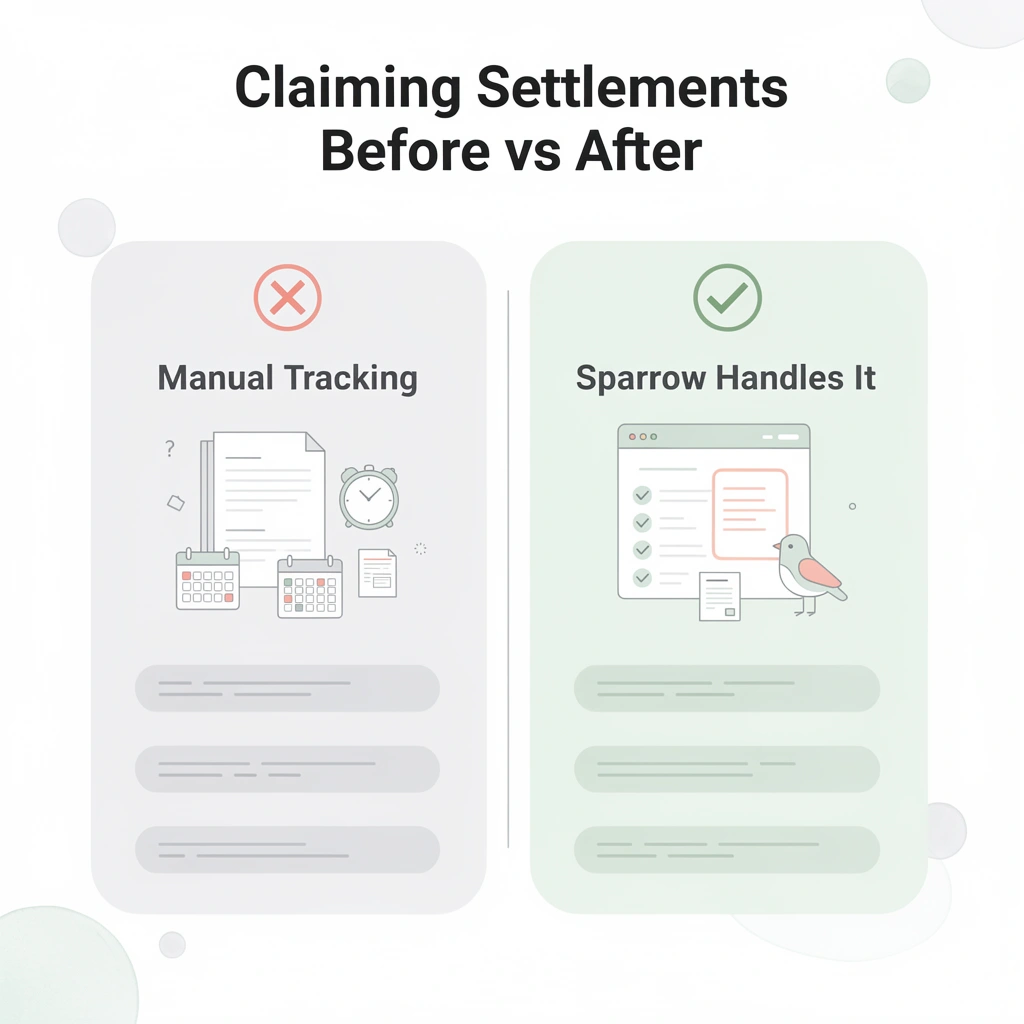
Searching by hand breaks down quickly. Bookmarking databases, scanning emails for class notices, or finding news articles sometimes work, but managing three or four claims simultaneously with different documentation requirements and staggered deadlines makes it harder to keep track of them and avoid missing one.
How does Sparrow simplify how class action settlements work for claimants?
Sparrow removes that hassle by tracking active settlements across the United States, automatically matching them to your profile, and filling in claim forms with information you already provided. What once took an afternoon of searching for receipts now takes minutes. According to the Sparrow Blog, the average Sparrow user claims over $345 per year, showing steady recovery across multiple settlements.
What makes the filing process actually work?
The failure point in most DIY claims is documentation. Settlement administrators require proof of purchase, account records, or transaction history that consumers often no longer have. Sparrow guides users through what’s required for each claim, organizes uploads, and verifies submissions against the settlement’s specific rules before sending. This pre-submission check distinguishes a successful claim from a rejection that is never corrected.
How does deadline management keep claims from slipping through?
Managing deadlines is straightforward. Sparrow keeps a live dashboard showing every active claim, its status, and its filing window. Reminders appear before deadlines, not after. At $84 per year, the subscription cost justifies itself even for a single mid-sized settlement and improves with additional claims.
How do class action settlements work once a claim is approved?
The payout tracking feature closes the loop in a way that manual claiming never could. Once approved, Sparrow provides real-time updates on when you can expect your money and how much it will be. You stop wondering whether a check is coming and start knowing when.
Once you understand what’s available to you, the only question left is where to start.
Related Reading
- Poppi Lawsuit
- At&t Lawsuit
- Fortnite Lawsuit
- Claim App
- Rocket Money
- Settlemate
- Is Settlemate Legit
- Truebill
- Catch
- Celsius Lawsuit
- Is Claimmoney.com Legit
Start Finding Money You May Be Owed with Sparrow
You now know how the process works, from notice to claim to distribution. Most people who miss out don’t lack eligibility—they lack a system that keeps pace with the process.
“Most people who miss out don’t lack eligibility—they lack a system that keeps pace with the process.”
⚠️ Warning: Without a dedicated system tracking deadlines and matches, even fully eligible claims slip through the cracks, and that money is gone forever.
🎯 Key Point: The average Sparrow user recovers over $345 per year — not because they worked harder, but because they stopped managing the process manually.
Join class action lawsuits through Sparrow, and that system exists from the moment you connect your profile. Our platform matches you to active settlements, pre-fills your claims, and tracks every deadline so nothing slips past you. The average user recovers over $345 per year — not because they worked harder, but because they stopped managing the process manually.
💡 Tip: Connecting your profile takes minutes — and from that point, Sparrow handles the matching, filing, and deadline tracking so you never have to.
| Manual Process | With Sparrow |
|---|---|
| Search for settlements yourself | Automatic matching to active settlements |
| Fill out every claim by hand | Pre-filled claims ready to submit |
| Track deadlines in a spreadsheet | Deadline tracking built in |
| Risk of missing payouts | Average $345+ recovered per year |

Leave a Reply