


Getting an email about a class action payout sounds promising until the process of actually claiming the money stops most people cold. Understanding what a class action lawsuit is is a useful starting point, but the real challenge is knowing where to look, what to file, and how to do it without spending hours on paperwork or legal research.
Sparrow solves that problem by scanning active settlements, matching users to claims they qualify for, and handling the filing process in minutes. No legal background is needed, and no money goes unclaimed simply because the process feels too complicated. People who are ready to collect what they are owed can join class action lawsuits through Sparrow and let the app do the work.
Table of Contents
- What Is the Claim App, and What Does It Offer?
- Why Do People Look for Claim App Alternatives?
- Which Features Matter Most When Comparing Class Action Claims Platforms?
- 7 Best Claim App Alternatives for Class Action Claims
- Key Factors to Consider Before Choosing a Claim App Alternative
- Why Consumers Trust Sparrow to Find and Claim Unclaimed Class Action Settlements
- Start Finding Money You May Be Owed with Sparrow
Summary
- Consumer awareness of class action settlements remains extremely low, and the gap between eligibility and actual payment is almost entirely a logistics problem. The median claim rate across 149 consumer class action settlements analyzed by the Federal Trade Commission was just 9%, with a weighted average of 4% across all notice recipients. Most eligible consumers never file, not because they lack standing, but because they never learned the case existed.
- Subscription billing models create a trust problem specific to claims platforms. Users frequently report signing up without fully registering a recurring charge, then watching fees accumulate across weeks or months while their actual claim recoveries stay at zero. That sequence, paying for a service that produces nothing retrievable, turns a convenience tool into a source of financial damage and erodes confidence in the entire category of settlement apps.
- Database quality matters more than database size when evaluating claims platforms. A curated list of 60 to 97 active, relevant settlements consistently outperforms a directory of 1,000-plus entries because volume without precision forces users into manual filtering, which they quickly abandon. The failure point is rarely access to settlements. It is the inability to quickly identify which ones actually apply to a specific user.
- Proof requirements quietly disqualify the majority of eligible claimants before they ever reach the filing stage. Settlements that demand purchase receipts from three years ago effectively exclude most consumers, not because they do not qualify, but because documentation that old rarely survives a phone upgrade or an email purge. The Duane Morris Class Action Review 2025 reported over $35 billion recovered in class action settlements in 2024, yet individual consumer recovery rates remain low, largely due to this documentation burden.
- Payout speed and disbursement method shape whether a platform has practically succeeded or only technically succeeded. A claim approved but delivered as a paper check six to eighteen months later compresses trust in a way that electronic disbursement, which can reduce that timeline from months to days, does not. The distance between “claim approved” and “money received,” measured in seasons rather than days, erodes confidence in ways that are difficult to rebuild.
- Repeated filing behavior, users returning for a second claim and then a third, is the clearest real-world signal that a claims platform is delivering on its core promise rather than just its onboarding experience. Platforms that carry a 4.2-out-of-5-star rating across verified app store reviews and offer a money-back guarantee when recoveries do not exceed the annual cost are making a testable, traceable promise rather than asking for open-ended trust.
- Sparrow’s class action lawsuit feature addresses the core discovery and filing barriers by scanning for verified, no-proof-required settlements on a weekly basis, pre-filling claim forms, and handling printing and mailing with postage covered, so the friction that causes most eligible consumers to miss deadlines is removed before it becomes a problem.
What Is the Claim App, and What Does It Offer?
Claim is a mobile app built on a simple idea: companies already owe you money through active class action settlements you don’t know about. The app matches consumers to settlements based on their purchase history and brand interactions, then handles the filing process so users don’t have to understand complex legal documents or track down court notices.
“Companies already owe consumers money through active class action settlements — most people just never find out.” — Claim App Core Premise
💡 What It Does: Claim scans your purchase history and brand interactions to automatically surface class action settlements you qualify for — then files on your behalf, no legal knowledge required.
🎯 Key Point: The entire filing process is handled for you — Claim eliminates the need to read legal documents, monitor court notices, or manually search for eligible settlements.
| Feature | What It Means for You |
|---|---|
| Automatic Matching | Pair your purchase history with eligible settlements |
| Hands-Free Filing | Submits claims without requiring legal knowledge |
| Settlement Tracking | Monitors active class action cases on your behalf |
| Brand Interaction Scan | Identifies qualifying activity across multiple companies |

How does the Claim App match you to active settlements?
The matching process works through a short onboarding questionnaire. You answer questions about brands you have used, such as Spotify, TikTok, GrubHub, or major retailers, and the app cross-references your responses against a database of hundreds of active settlements covering data breaches, defective products, fake discounts, unauthorized charges, and robocall violations. Many settlements require no proof—no old receipts or account records. You simply confirm your eligibility, and Sparrow prepares your submission.
How does Claim App remove the friction of filing manually?
Most people who try to file claims independently hit a wall between finding the right administrator and completing legal forms. The typical pattern: bookmark a settlement page, plan to return, miss the deadline. Our Join class action lawsuits service eliminates this friction by handling form preparation, printing, and mailing, reducing the process from an afternoon to minutes.
What does it cost, and is it worth it?
The app costs $5.99 per week or $59.99 per year and includes automated settlement matching, form generation, deadline alerts, and a real-time dashboard that tracks claims from submission through payout. Payouts typically arrive one to twelve months after a claim deadline closes, so the value grows as more claims are filed.
Does the Claim App give access to settlements you can’t find elsewhere?
Filing directly on official settlement websites is always free. The subscription buys convenience and the ability to find settlements, not access to settlements that would otherwise be unavailable. For anyone who missed a payout deadline because they didn’t know a case existed, that distinction matters. But even a well-designed app with strong ratings raises a more complicated question.
Related Reading
- What Is A Class Action Lawsuit
- What Is A Class Action Settlement
- How Do Class Action Settlements Work
- How To Find Unclaimed Money
- Are Class Action Settlements Taxable
- Doge Transparency FOIA Lawsuit
- General Motors V8 Engine Lawsuit
- Shannon Sharpe Lawsuit
- Google Android Cellular Data Lawsuit
- Pima County Sheriff Lawsuit
- Ozempic Lawsuit
Why Do People Look for Claim App Alternatives?
People search for alternatives when a tool creates more problems than it solves. Users arrive expecting an easy path to money they are owed, and instead encounter billing surprises, dead-end links, and claim rates so low the service feels like a second loss stacked on top of the first.
“Users arrive expecting an easy path to money they are owed. Instead, they encounter billing surprises, dead-end links, and claim rates so low the service feels like a second loss stacked on top of the first.”
💡 Tip: If a claims tool charges you before you’ve recovered anything, that’s a major red flag. A trustworthy alternative should make the process easier, not costlier.
⚠️ Warning: Low claim success rates, unexpected fees, and broken user experiences are the top three reasons people abandon a claims app and seek alternatives.

When does a claim app turn billing into the real problem?
The failure point is usually discovered on a bank statement, not inside the app. Users report signing up without fully understanding the recurring charge, then watching fees add up across weeks or months while their actual claim recoveries remain at zero. Paying for a service that produces nothing recoverable turns a convenience tool into financial damage. People came to recover money and ended up needing to recover money from the recovery service itself.
How does misleading framing erode trust in a claims app?
Misleading framing worsens the problem. When an app claims to be a claims platform but mainly shows links to government websites or old settlement pages, it repackages the problem rather than solving it. Users who enter their information only to discover the deadline has passed or that they need the same documents feel tricked, damaging trust in all settlement tools.
Why do claim rates stay so low without a claim app?
The low success rate reveals a fundamental problem with consumer class actions. According to the Federal Trade Commission’s analysis of 149 consumer class action settlements, only 9% of people claimed their money in the middle group, with an average of 4% across all recipients of notice. When a tool creates barriers rather than facilitating claims, this already-low rate declines further.
How does a claim app recover the money left on the table?
Most people manually track settlements and file when they remember, missing opportunities because they discover them too late. Unclaimed funds revert to the defendants or to state cy pres funds, while eligible consumers receive nothing. Platforms like Sparrow solve both problems: automated discovery of no-proof settlements you already qualify for, and full handling of paperwork, printing, and mailing to eliminate the friction that kills most claims.
Trust, Once Lost, Drives the Search
Trustpilot reviews and app store feedback show the same pattern: users stop trusting tools when they cannot predict charges or whether submissions reach claims administrators. Transparency is noticed when it is absent. A platform charging $7 monthly while averaging $345 in annual recoveries per user makes a clear, testable promise. One that charges without delivering traceable outcomes asks for faith users no longer have.
What do users actually want from a claim app?
People searching for alternatives don’t want a different app with the same features. They want to remove the barrier between eligibility and payment. Identifying which features close that gap is less obvious than it appears.
Which Features Matter Most When Comparing Class Action Claims Platforms?
Good settlement recovery tools work well because of four critical things: a database that has the right information, easy filing, reliable tracking, and fast payouts. Each of these is essential because eligible money either reaches you or gets lost in the administrative process.
“The difference between a great and a poor claims platform comes down to four pillars: data quality, filing simplicity, tracking reliability, and payout speed — get any one wrong and eligible money disappears.”
| Feature | Why It Matters | Risk If Missing |
|---|---|---|
| Right Database | Ensures you’re matched to every eligible claim | Missed settlements, lost compensation |
| Easy Filing | Reduces errors and drop-off during submission | Incomplete claims, disqualification |
| Reliable Tracking | Keeps you informed at every stage | Missed deadlines, no visibility |
| Fast Payouts | Delivers recovered funds without unnecessary delay | Funds held up in administrative limbo |
🎯 Key Point: The best class action platforms don’t just find claims — they ensure every step, from discovery to deposit, is airtight and efficient.
💡 Tip: When evaluating a platform, always test all four pillars before committing — a tool that excels at filing but fails at tracking can still cost you real money.

Does database depth matter more than database size?
A carefully chosen list of 60 to 97 active, relevant settlements works better than a huge directory of 1,000-plus entries. When users must manually check every result for relevance or currency, most stop looking. Excessive options without precision create clutter. The real problem is usually not finding settlements, but quickly identifying which ones suit their needs.
How does a claim app reduce filing friction?
In-app filing transforms this dynamic. When a claims platform forces users to leave the app, create a new account on a third-party administrator’s website, and re-enter information already provided, the friction suppresses participation rates across consumer settlements. According to Talli.ai’s class action settlement statistics, over 500,000 recipients have been paid across settlement distributions, yet that represents a fraction of those eligible. The gap between eligibility and payment stems not from qualification but from whether the filing process was simple enough to complete.
How does a claim app keep you engaged over multi-year timelines?
Most people handle settlement tracking by bookmarking a confirmation email and hoping for the best. This works until the resolution timeline stretches past two years, which it routinely does, and the email gets buried or forgotten. Platforms with deadline alerts, status updates, and active notifications solve a real behavioral problem: human attention cannot sustain across multi-year timelines without structured reminders. Platforms like Sparrow address this by handling form-filling, printing, and mailing on your behalf, removing the manual re-engagement that causes most eligible claimants to drop out of the process.
Why payout speed and proof requirements define real-world recovery
Proof requirements matter more than most comparison guides acknowledge. Settlements demanding purchase receipts from three years ago exclude eligible claimants not because they lack qualifications, but because documentation that old rarely survives a phone upgrade or email purge. Platforms prioritizing no-proof or minimal-documentation claims dramatically increase the share of eligible users who successfully complete submissions. The Duane Morris Class Action Review 2025 reported over $35 billion recovered in class action settlements in 2024, yet individual consumer recovery rates remain fractional because documentation burdens quietly disqualify people unaware they’ve been excluded.
How does payout speed determine whether a Claim App actually delivers?
Payout speed closes the loop. A platform that approves claims but delivers payment six to eighteen months later has technically succeeded while practically failing. Electronic disbursement compresses that timeline from months to days, which matters both practically and psychologically. Trust erodes when the distance between “claim approved” and “money received” is measured in seasons rather than days.
Why does security design determine whether a Claim App can work at all?
The best settlement discovery tool fails if the security design makes users hesitant to share the purchase history needed for accurate matching. End-to-end encryption and intuitive interfaces are baseline conditions for participation, not premium features. That quiet confidence in the platform—the willingness to connect accounts and let the system work—is the one feature that makes every other feature matter.
Related Reading
- Nightfall Group Lawsuit
- Gmail Class Action Lawsuit
- Temu Lawsuit
- AT&T Class Action Lawsuit
- Amazon Fire TV Stick Lawsuit
- Apple Class Action Lawsuit
- Life360 Lawsuit
- Dapper Development Lawsuit
- Capital One Class Action Lawsuit
- Minnesota Ice Lawsuit
- Costco Sonoma County Lawsuit
- Isotonix Lawsuit
- Hexclad Lawsuit
- Turbotax Lawsuit
- Amazon Prime FTC Settlement Lawsuit
7 Best Claim App Alternatives for Class Action Claims
The best class action claims platform saves time, eliminates subscription costs, protects your personal information, surfaces more eligible claims, and makes it easier to recover money you’re legally entitled to receive. The platforms below solve the biggest frustrations users experience with Claim — whether that’s pricing, automation, claim discovery, or ease of use.
“The best alternatives to Claim don’t just match its features — they eliminate subscription costs, surface more eligible claims, and put more money back in your pocket.” — Key Insight
💡 Tip: When evaluating alternatives, prioritize platforms that offer automatic claim discovery — manually searching for eligible claims wastes time and means you likely miss payouts you’re entitled to.
⚠️ Warning: Not all class action platforms are equal. Some charge recurring subscription fees that can easily exceed the value of claims recovered — always check the pricing model before signing up.
| Feature | What to Look For | Why It Matters |
|---|---|---|
| Pricing Model | Free or commission-based | Avoid subscription costs eating into payouts |
| Claim Discovery | Automated matching | Surfaces have more eligible claims with less effort |
| Data Privacy | Minimal data sharing | Protects your personal information |
| Ease of Use | Simple submission flow | Reduces time spent recovering money |
🔑 Takeaway: The right platform combines zero upfront cost, automated discovery, and strong privacy protections — making it effortless to claim every dollar you’re owed.

1. Sparrow
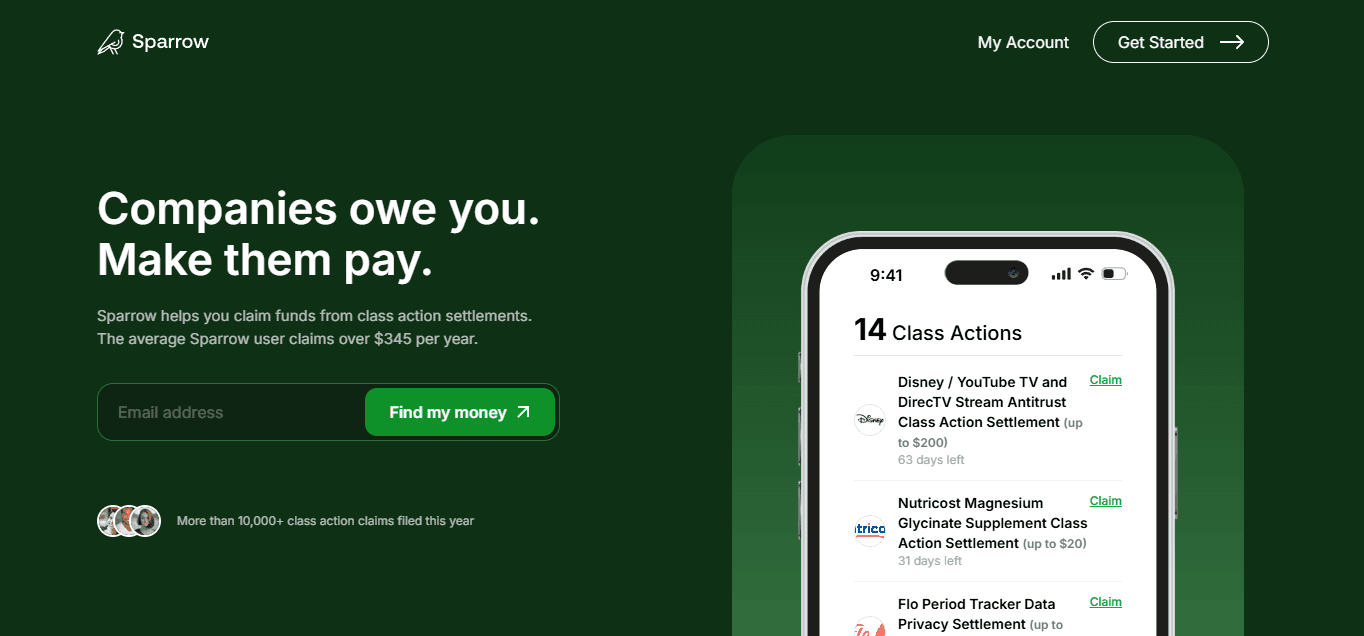
Sparrow, at https://usesparrow.com/, is a class-action discovery and filing platform that scans for settlements and handles submissions for users. It focuses on opportunities requiring no proof, prints and mails completed forms, and offers a money-back guarantee to address subscription charges, expired links, low claim success, and time-consuming paperwork.
Key Features
- Weekly curated, no-proof class actions users are likely to qualify for, with unreliable or expired listings removed.
- Automatic printing and physical mailing of pre-filled claim forms with postage paid.
- Money-back guarantee refunding the difference if annual recoveries don’t exceed the subscription cost.
- Access to high-value settlements, including Comcast Xfinity up to $10,000 and Flo Period Tracker up to $700.
- One-time information entry enables multiple claims to be filed in minutes.
- Clear eligibility requirements and deadlines for each settlement.
- Independent self-help operation with explicit statements of non-affiliation with administrators.
- Court-approved cases requiring minimal documentation.
- Personalized weekly updates on new lawsuits.
- Over 10,000 claims have been filed this year, accompanied by positive user testimonials.
Pros
Genuine time savings through automation; performance-based guarantee reduces financial risk; high volume of accessible, high-value settlements; strong user feedback on simplicity.
Cons
An annual subscription requires an upfront commitment.
Accessibility
User-friendly web platform at https://usesparrow.com/ optimized for desktop and mobile. The $84 annual plan ($7/month equivalent) includes easy cancellation and money-back protection.
2. Catch
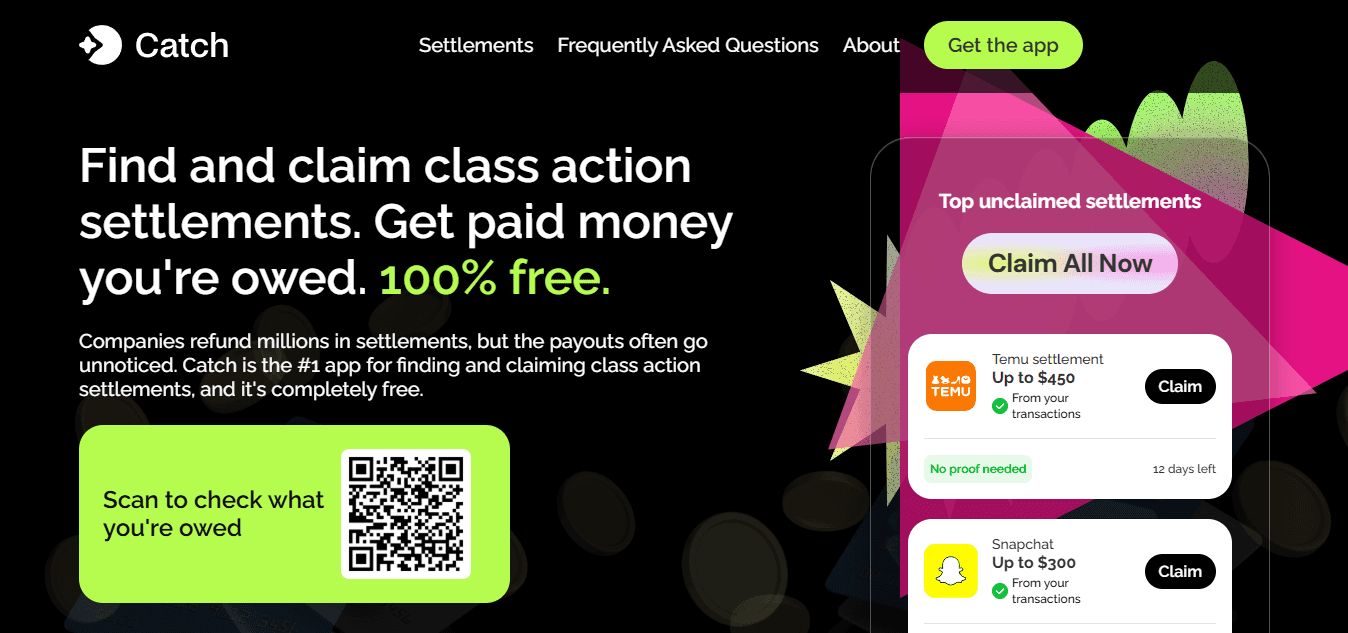
Catch gives you a free, mobile-first experience that automatically matches you to settlements based on transaction insights and brand usage. It removes subscription fees while offering broad coverage and simple tap-to-file options that boost participation rates.
Key Features
- 100% free access with no subscriptions or hidden charges.
- Automatic matching based on common brands and purchase patterns.
- Clear explanations of each settlement, potential payouts, and proof requirements.
- Quick in-app claim submission in just a few taps.
- Support for both no-proof and documentation-needed cases.
- Regular updates on new settlement opportunities.
- Integrated tracking for submitted claims and payout status.
Pros
Zero-cost barrier removes financial risk; fast, intuitive interface; high volume of active settlements without upfront commitment.
Cons
May require manual transaction uploads for optimal matching in some cases; payouts subject to administrator timelines.
3. Payout Claim Class Actions
Payout delivers a highly-rated app for finding and filing overlooked settlements. Its guided processes and status updates maintain user engagement despite low claim success rates. Support is available from filing through payout.
Key Features
- Rapid claim filing in under five minutes for multiple settlements.
- Extensive database covering dozens of active cases with brand-specific matches.
- Detailed case summaries including expected amounts and requirements.
- Built-in reminders and progress tracking to prevent missed deadlines.
- High user ratings emphasize ease and actual recoveries.
- Support for common consumer issues, such as privacy and product defects.
- Free core access with straightforward navigation.
Pros
Excellent app ratings and real user success stories; saves time; organized dashboard reduces confusion.
Cons
Some advanced features may involve optional in-app elements and rely on user input for eligibility.
4. Top Class Actions
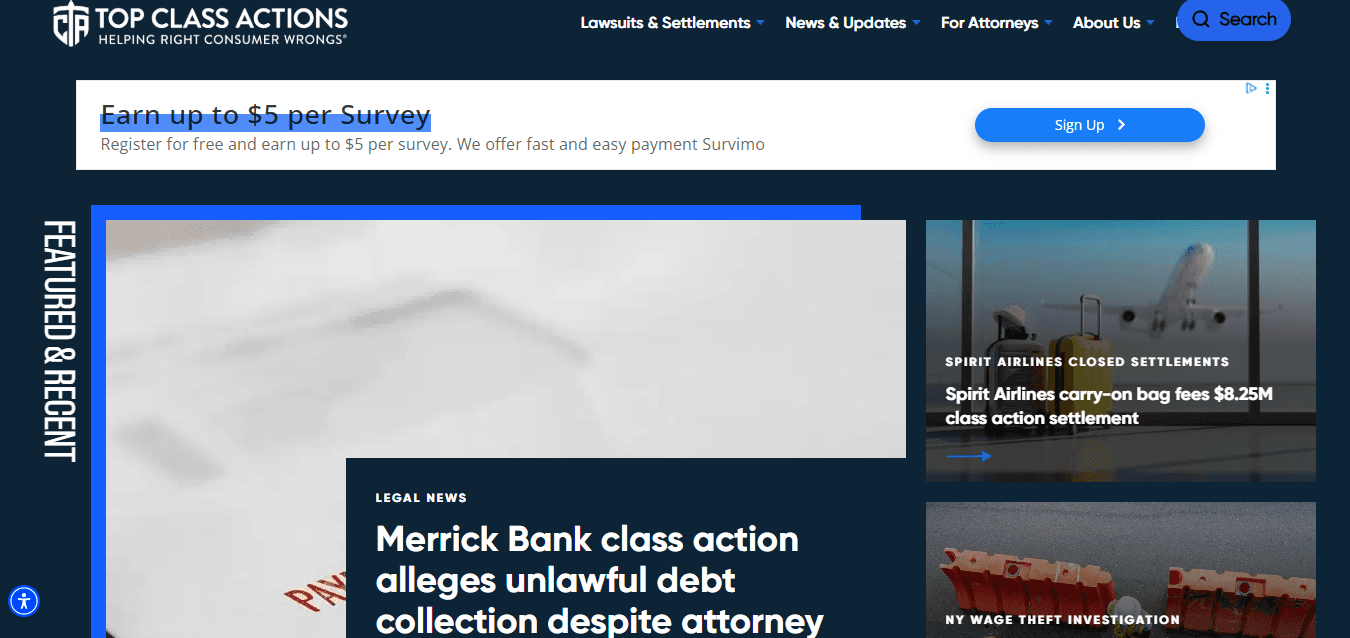
Top Class Actions is a comprehensive news and settlement hub that lists verified open cases and provides direct filing guidance. It prioritizes transparency and helps users avoid false information by featuring only court-approved opportunities.
Key Features
- Regularly updated database of legitimate open settlements and rebates.
- Detailed articles explaining each case with eligibility criteria.
- Direct links to official claim forms and administrator sites.
- Focus on no-proof options where available for easier qualification.
- News on upcoming and paying out settlements.
- Tools to help consumers stay informed without subscriptions.
- Long-standing reputation since 2008 for accurate listings.
Pros
You can browse and use all resources for free; detailed explanations build trust; claims have a good chance of approval because many people can see them.
Cons
Filing requires more work than automated services; you must submit forms yourself.
5. ClassAction.org
ClassAction.org is an independent resource offering tools, news, and direct access to settlements. It focuses on educating consumers through clear databases and newsletters to combat doubt and low participation.
Key Features
- Free searchable database of open class action settlements.
- Weekly newsletter with updates on new cases.
- Educational resources explaining the claims process in plain terms.
- Listings with specific payout ranges and deadlines.
- No affiliation with paid services for unbiased information.
Pros
Strong focus on free, trustworthy information; comprehensive coverage; support informed decision-making.
Cons
Mainly informational with manual filing required; limited automation for form completion.
6. Settlemate
Settlemate offers end-to-end automation for finding, filing, and tracking class action claims focused on product defects and consumer recovery, eliminating manual work through real-time dashboards and proactive alerts.
Key Features
- Full automation from discovery to filing with minimal user input.
- Specialized matching for defective products and high-value cases.
- Real-time claim tracking dashboard with payout notifications.
- Clear identification of no-proof settlements reduces documentation needs.
- Alerts for deadlines and status changes.
- Multi-claim management in one centralized location.
- Verification of court-approved opportunities only.
Pros
Comprehensive automation saves substantial time, strong tracking reduces uncertainty, and tailored features target high-impact categories.
Cons
May require a subscription for premium features; focused scope might miss niche cases.
7. Class Action Buddy
Class Action Buddy combines smart matching with digital filing tools in an easy-to-use app, addressing low success rates and billing issues through a limited number of free monthly claims and fast submission.
Key Features
- Smart eligibility matching based on your profile and history.
- Digital form auto-fill and submission abilities.
- Monthly allowance of free claims before paid access.
- Detailed case breakdowns with payout estimates and requirements.
- Mobile app for filing and monitoring on the go.
- Focus on verified settlements to build user confidence.
- Streamlined interface that reduces submission errors.
Pros
A mix of free and paid options lowers barriers to entry, fast digital processes, and high usability for everyday consumers.
Cons
Full unlimited access requires payment; the platform is newer than established databases.
Key Factors to Consider Before Choosing a Claim App Alternative
Class action claims platforms are far from identical — and the differences matter more than most people realize. Some focus on automation, others offer free access or claim tracking, and each comes with its own trade-offs. Comparing key factors before signing up helps you choose a service that genuinely saves time, protects your personal information, and increases your chances of recovering every dollar of eligible settlement money you’re owed.
“The right claims platform can mean the difference between missing a settlement deadline and recovering hundreds of dollars you didn’t even know you were owed.” — Settlement Industry Insight
| Factor | Why It Matters | What to Look For |
|---|---|---|
| Automation | Saves time on repetitive filings | Auto-fill and submission features |
| Free Access | Reduces upfront risk | No-cost signup with transparent fee structure |
| Claim Tracking | Keeps you informed | Real-time status updates and notifications |
| Data Protection | Safeguards personal info | Encryption, privacy policy, data-sharing limits |
| Settlement Coverage | Maximizes recovery | Broad database of active and past claims |
💡 Tip: Before committing to any platform, always review its privacy policy — some services monetize your personal data, which defeats the purpose of using them in the first place.
⚠️ Warning: Don’t assume free platforms are always the best choice. A truly valuable service balances zero upfront cost with robust claim-matching capabilities — not just a basic sign-up form.
🎯 Key Point: The most important question to ask is whether a platform actively finds claims for you or simply waits for you to do the research yourself. Proactive claim discovery is the feature that separates good tools from great ones.

Cost Structure and Value Guarantee
Look at the pricing model carefully, since hidden or repeating charges can reduce what you recover. Find platforms that offer clear annual or monthly fees with performance guarantees, such as money-back options if your claim falls short of subscription costs. Free options remove financial risk but may lack advanced automation, while paid services justify their cost through time savings and higher filing success. Calculate possible yearly earnings against cost using average user recovery figures of around $345 to confirm a positive return on investment.
Ease of Use and Filing Automation
Choose services with easy-to-use interfaces that reduce manual work. Look for features like pre-filled forms, single data entry, and automatic submissions or mailings. The best options simplify the entire process, from eligibility checks to final paperwork submission. They also help navigate complicated legal documents and meet deadlines. Test the platform’s mobile functionality and assess dashboard clarity. These factors determine whether the tool fits your schedule. Good automation increases participation by removing barriers that prevent eligible people from signing up.
Database Size and Settlement Quality
Look at how many cases are available and whether they matter to you. Focus on platforms that maintain long, up-to-date lists of verified, court-approved settlements across categories like data breaches and product defects. Seek clear details on potential payouts, required documentation, and application deadlines for each opportunity. Strong alternatives offer no-proof-required options and high-value claims involving popular brands, increasing your chances of meaningful recovery while reducing research time. Ensure the service obtains information directly from official administrators to confirm accuracy.
Transparency and Independence
Pick providers that clearly identify themselves as self-help tools and operate independently from law firms, administrators, or defendants. Trustworthy platforms disclose their limitations, such as the inability to guarantee claim approval or predict compensation amounts. They maintain independence to avoid conflicts of interest. Review their privacy policies to confirm they do not sell your information. This transparency enables users to make informed decisions when submitting claims.
Tracking and Notification Features
Good alternatives include strong progress monitoring with real-time updates, deadline reminders, and payout alerts to keep claims moving from submission to distribution. These tools prevent oversights that lead to lost funds during typical 6-12-month-or-longer payout windows. Look for centralized dashboards that display the status of all active claims, eliminating the need for repeated manual checks.
User Feedback and Proven Track Record
Read independent reviews and testimonials to understand success rates and service reliability. Well-known platforms demonstrate effectiveness through high claim volumes and positive recovery feedback. Note what users report about customer support responsiveness and overall satisfaction. Check multiple sources to gain a fair picture beyond marketing claims.
Security and Data Privacy Practices
Ensure the service uses strong data protection measures, especially since claims require personal information. Good alternatives provide clear opt-out options and collect only information needed for matching and filing. Avoid platforms with reports of unauthorized charges or data breaches.
Why Consumers Trust Sparrow to Find and Claim Unclaimed Class Action Settlements
People trust Sparrow because it solves the two core problems that actually stop people from collecting settlement money: not knowing a case exists and not having the time or patience to file before the deadline.
“The biggest barriers to claiming settlement money aren’t eligibility — they’re awareness and friction. Remove those two obstacles, and consumers can finally collect what’s rightfully theirs.” — Sparrow
🎯 Key Point: Sparrow tackles both barriers at once — it finds the settlements you never knew existed and handles the filing process before the deadline passes.
💡 Tip: Most people leave settlement money unclaimed not because they’re ineligible, but because they simply never heard about the case or ran out of time to act.
| Barrier to Claiming | What Sparrow Does |
|---|---|
| Not knowing a case exists | Automatically discovers matching settlements for you |
| No time to file | Streamlines the entire claim process in minutes |
| Missing the deadline | Sends timely alerts so you never miss a cutoff |
Why do most people miss class-action deadlines before finding a claims app?
Most people discover settlements by accident—through forwarded emails, news stories, or conversations with friends. The problem is that class action deadlines don’t wait. By the time a settlement enters the conversation, the filing deadline is often nearly closed. Consumers lost real money not because they didn’t qualify, but because they learned about it too late.
How does a claim app shift settlement discovery from reactive to proactive?
Sparrow changes discovery from reactive to proactive. The platform scans for verified, court-approved settlements weekly, filters for no-proof-required cases, and surfaces only what’s relevant to each user before deadlines become a problem. A targeted alert about a case where you’re eligible, with the form pre-filled and envelope addressed, delivers results rather than information.
Joining class action lawsuits through Sparrow removes the paperwork burden that discourages eligible consumers from claiming refunds. Our platform prints, fills out, and mails claim forms with postage covered, eliminating the friction that turns a five-minute task into procrastination. According to the App Store listing for Sparrow AI Refund Helper, the app has a 4.2-star rating out of 5 from 122 user reviews, reflecting consistent follow-through on its promise. Users who receive checks after filing through Sparrow file more claims.
What makes the trust sustainable?
The yearly price of $84 comes with a money-back guarantee, making the choice safer: you can’t lose much money and might recover funds companies already owe you. Sparrow operates independently from law firms, administrators, and defendants, so the information it provides has no hidden agenda. When a platform doesn’t benefit from pushing you toward one settlement over another, you can trust what it tells you.
How does a claim app build trust through repeated use?
The real measure of trust is whether users return after their first claim to file a second and then a third. That repeated behavior is the only signal that matters.
Start Finding Money You May Be Owed with Sparrow
When users file a claim a second time and then a third time, it shows that the system works. When the process is honest and transparent, the results stay the same, and costs are easy to predict.
“When the process is honest, the results stay the same and costs are easy to predict.” — Sparrow User Experience
💡 Tip: Repeat failures are the strongest proof of a system’s reliability. If it didn’t work, no one would come back.

If you qualify for settlements you’ve never heard of, the smart choice is clear. Join class action lawsuits through Sparrow, which looks for active cases that don’t need proof, fills in your claims for you, and mails the paperwork with postage paid.
| Sparrow Feature | What It Means for You |
|---|---|
| Finds active cases | No research required on your end |
| Pre-fills your claims | Zero manual paperwork |
| Postage-paid mailing | Completely hands-off process |
| Money-back guarantee | Risk-free if recoveries don’t exceed $84/year |
⚠️ Warning: Settlement deadlines are real — once they close, that money is gone forever. Don’t wait.
🎯 Key Point: Everything is backed by a money-back guarantee if your recoveries do not exceed the $84 annual cost — making this a virtually risk-free opportunity to claim money you’re already owed.
Related Reading
- Fortnite Lawsuit
- Is Claimmoney.com Legit
- Truebill
- Catch
- Rocket Money
- Celsius Lawsuit
- Is Settlemate Legit
- Poppi Lawsuit
- At&t Lawsuit
- Settlemate

Leave a Reply