

Google may owe millions of Android users money. Even when apps were set to “Wi-Fi only,” Google apps were quietly consuming cellular data in the background, triggering a class action lawsuit that could put real dollars back in affected users’ pockets. Understanding what a class action lawsuit is helps here: it is a legal case in which a large group of people with the same grievance takes on a corporation together, dividing any settlement among eligible claimants.
Qualifying for a payout does not require hiring a lawyer or wading through confusing paperwork. Sparrow simplifies the entire process, helping users confirm eligibility and submit claims without the usual headaches, making it one of the easiest ways to join class action lawsuits.
Table of Contents
- What Is the Google Android Cellular Data Lawsuit?
- Who Is Eligible for the Google Android Cellular Data Lawsuit Settlement?
- What Does the Google Android Cellular Data Lawsuit Settlement Cover?
- 7 Key Facts to Know About the Google Android Cellular Data Lawsuit
- How to File a Google Android Cellular Data Lawsuit Claim
- How Sparrow Makes It Easier to Find and Claim Settlement Money
- Start Finding Money You May Be Owed with Sparrow
Summary
- Class action settlements involving major technology companies often go unclaimed not because users are ineligible, but because awareness and access remain the primary barriers. The Google Android cellular data lawsuit, formally known as Joseph Taylor et al. v. Google LLC, covers activity from November 12, 2017 onward and resulted in a $135 million federal settlement plus a separate California jury verdict of over $314 million awarded in July 2025. The scale of both outcomes reflects how widespread the underlying behavior was across the Android ecosystem.
- Eligibility for the federal settlement is broader than most Android users assume. Over 100 million people are potentially eligible, and qualification is based on device usage and access to a paid cellular plan during the covered period, not on the ability to produce billing records, overage documentation, or any proof of specific financial harm. Carrier switches, device upgrades, and canceled plans do not remove someone from the eligible class.
- The behavior at the center of this lawsuit was not a software glitch. Android devices reportedly transmitted data to Google servers during idle periods, with apps closed and location services disabled, drawing from paid cellular plans without user knowledge or consent. Courts treated this as a quantifiable financial loss, which is why the settlement fund exists specifically to compensate for the data consumed rather than to address a generalized privacy concern.
- The settlement delivers two distinct forms of relief. Cash compensation is distributed on a pro rata basis from the fund, with provisions for supplemental payments of up to $100 per person if residual funds allow. Google also agreed to binding changes, including updated Play Terms of Service language, clearer disclosures during new device setup, and improved visibility into non-essential cellular data usage. These are enforceable commitments, not voluntary improvements.
- The gap between eligibility and payment is primarily a logistics problem. Most eligible users never file because settlement notices get buried in spam folders, are posted on court websites with little traffic, or are circulated through word of mouth after deadlines have already passed. When filing forms, the use of legal language and unfamiliar processes causes a significant percentage of eligible claimants to abandon the submission before completing it.
- Unclaimed settlement money is a recurring pattern across consumer protection cases, not an isolated outcome tied to any single lawsuit. Eligible consumers routinely walk away from funds that courts have already determined they are owed, simply because the discovery and filing process creates too much friction at each step.
- Sparrow addresses this by continuously monitoring active settlements, automatically matching them to user profiles, and handling the filing steps so eligible claimants can submit in minutes rather than navigating legal documents or reconstructing years of account history on their own.
What Is the Google Android Cellular Data Lawsuit?
The Google Android Cellular Data Lawsuit is a federal class action that alleges Google’s Android operating system used people’s paid cellular data to send information to Google servers without clear permission and without waiting for Wi-Fi. The case, formally known as Joseph Taylor et al. v. Google LLC, covers activity from November 12, 2017, onward and targets a practice that plaintiffs argue turned everyday users into unwitting subsidizers of Google’s data operations.
“The lawsuit alleges that Google’s Android OS transmitted data to Google servers using users’ paid cellular data — without explicit consent and regardless of Wi-Fi availability.” — Joseph Taylor et al. v. Google LLC
🎯 Key Point: This is a federal class action lawsuit — meaning any Android user affected from November 12, 2017, onward may potentially be included, not just the named plaintiffs.
💡 What This Means for You: If you owned an Android device after November 12, 2017, and your paid cellular data was consumed by background transmissions to Google servers, you could be considered a class member in this ongoing case.
| Case Detail | Information |
|---|---|
| Case Name | Joseph Taylor et al. v. Google LLC |
| Case Type | Federal Class Action |
| Defendant | Google LLC |
| Coverage Start Date | November 12, 2017 |
| Core Allegation | Unauthorized use of paid cellular data |
| Affected Platform | Android Operating System |

How the settlement took shape
According to ClassAction.org, Google agreed to a $135 million settlement to resolve claims from U.S. Android users outside California. A related California state case resulted in a jury finding Google liable in July 2025 and awarding over $314 million in damages to California users. Google denied wrongdoing but agreed to improve disclosures about the use of background data. Android devices reportedly sent data during idle moments with apps closed and location services disabled, using cellular data that users had already paid their carriers for. This structural decision redirected a real financial cost onto consumers without their knowledge.
Why do so few people claim money from the Google Android Cellular Data Lawsuit?
Most people who qualify for this settlement never claim a dollar because they don’t hear about it or assume the filing process is too complicated. Platforms like Sparrow address this by surfacing no-proof-required claims and walking users through filing in minutes, removing the friction that prevents eligible people from completing the process. ClassAction.org reports that over 100 million Android users are potentially eligible for cash from this settlement, a significant portion of the American smartphone-owning population. The barrier has always been awareness and access, not qualification.
What does it mean that the legal work is already done?
Settlements like this represent money that courts have already decided consumers are owed. The legal work is done. The question is whether you know you qualify. But figuring out who fits inside that 100 million requires surprisingly specific details.
Who Is Eligible for the Google Android Cellular Data Lawsuit Settlement?
If you owned or used an Android device connected to a paid cellular data plan between November 12, 2017, and the final approval date, you qualify. This includes phones you no longer own, carriers you switched away from, and plans you canceled years ago.
“Eligibility extends to phones you no longer own, carriers you switched away from, and plans cancelled years ago: meaning far more people qualify than realise it.”
🎯 Key Point: You do not need to currently own the device or be on the same carrier. Past ownership counts.
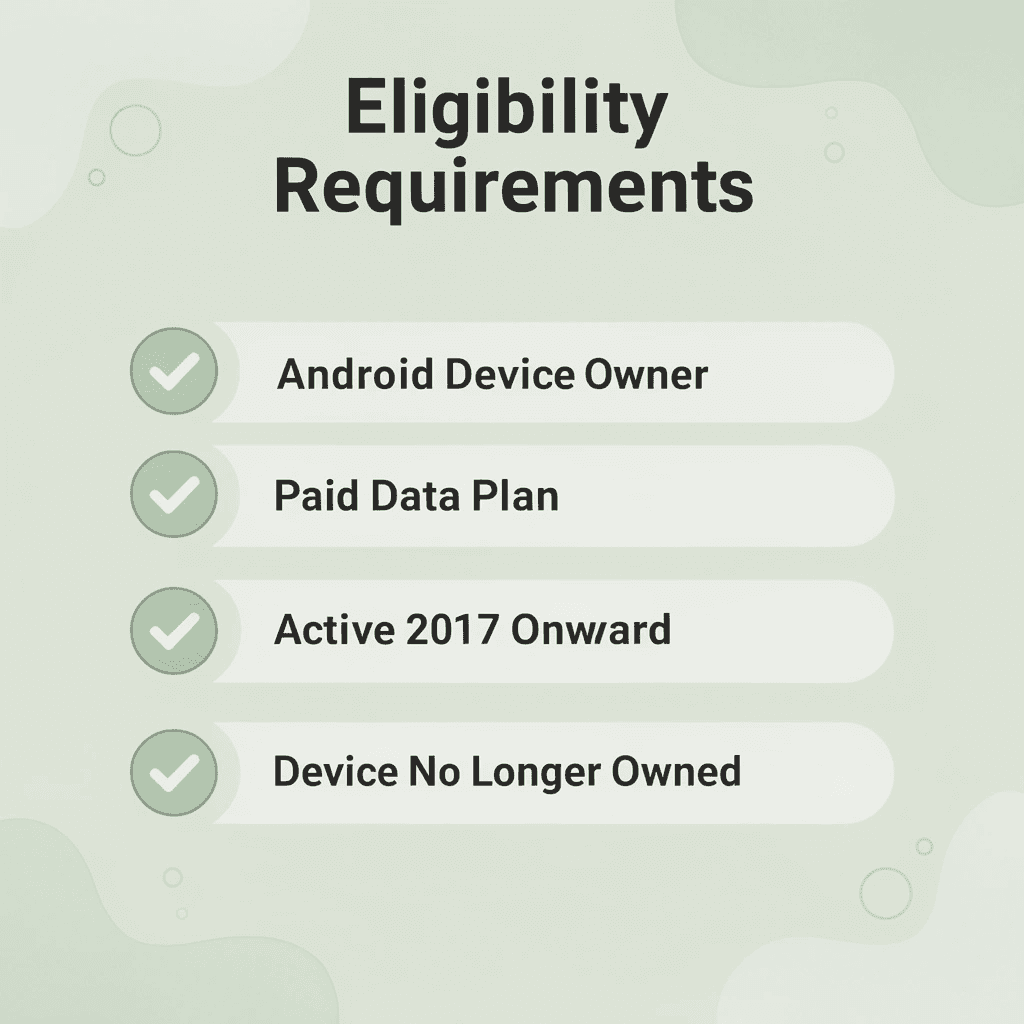
According to ClassAction.org, over 100 million Android users are potentially eligible for compensation. Each Android device that connected to a cellular network — rather than relying solely on Wi-Fi — during this period counts toward eligibility.
| Eligibility Factor | Qualifies? |
|---|---|
| Android device on a paid cellular plan | ✅ Yes |
| Device you no longer own | ✅ Yes |
| Carrier, you switched away from | ✅ Yes |
| Canceled plan for this period | ✅ Yes |
| Wi-Fi-only device (no cellular) | ❌ No |
🔑 Takeaway: With over 100 million potentially eligible users, this is one of the largest consumer data settlements in Android history — most qualifying users simply don’t know they have a claim.
What actually disqualifies you?
The clearest exclusion applies to California residents who were part of the separate Csupo v. Google LLC case. You cannot be a Google employee, an immediate family member of one, or a judge assigned to the case. For most Android users, none of those apply.
Does the Google Android Cellular Data Lawsuit require proof of harm to qualify?
Most people who think they don’t qualify are wrong: they believe you need to show specific harm, a receipt, a billing statement, or documentation of an overage charge. You don’t. The settlement class is defined by device usage and cellular plan access during the covered period, not by your ability to produce paperwork. That friction is why so many eligible people walk away empty-handed. Platforms like Sparrow are built to fill this gap, surfacing no-proof-required claims and handling the filing so users can submit in minutes rather than reconstruct years of account history.
Does switching carriers or devices affect your claim?
No. Eligibility follows the person, not the account. If you used a qualifying Android device during the covered window, carrier changes, device upgrades, and service gaps won’t disqualify you. According to WGN-TV’s reporting on the $135 million settlement, the fund compensates users whose paid cellular data was used without their knowledge or permission, regardless of which carrier billed them.
Why does the Google Android cellular data lawsuit cast such a wide net for eligibility?
The settlement’s reach is deliberately wide because background data transfers occurred consistently across the Android ecosystem during those years, regardless of carrier, device model, or plan tier. This is why the eligibility window is expansive, and the inclusion threshold remains low.
What does the Google Android cellular data lawsuit settlement actually cover?
But knowing you qualify is only half the picture. What the settlement actually covers is more specific than most people think.
Related Reading
- What Is A Class Action Lawsuit
- What Is A Class Action Settlement
- How Do Class Action Settlements Work
- How To Find Unclaimed Money
- Are Class Action Settlements Taxable
- Doge Transparency FOIA Lawsuit
- General Motors V8 Engine Lawsuit
- Shannon Sharpe Lawsuit
- Google Android Cellular Data Lawsuit
- Pima County Sheriff Lawsuit
- Ozempic Lawsuit
What Does the Google Android Cellular Data Lawsuit Settlement Cover?
The settlement gives two different types of help. ClassAction.org reports that more than 100 million Android users can get cash from the fund. The money is distributed on a pro rata basis, which means each person gets a fair share after the costs to run the program and attorney fees are taken out. Any money that is left over goes straight to the people in the class. There are also rules that allow for extra payments up to $100 per person if there is extra money available.
“More than 100 million Android users can get cash from the fund, distributed on a pro rata basis — meaning every eligible person receives their fair share.” — ClassAction.org
🎯 Key Point: The pro rata distribution model ensures that no single claimant takes a disproportionate share — every eligible user gets a fair cut of the remaining funds after fees.
💡 Tip: Make sure to file your claim as early as possible. With over 100 million potential claimants, the sooner you submit, the better positioned you are to receive your share — including any bonus payments up to $100.
| Settlement Feature | Details |
|---|---|
| Eligible Users | More than 100 million Android users |
| Distribution Method | Pro rata (equal fair share) |
| Deductions | Program costs + attorney fees |
| Leftover Funds | Returned directly to the class members |
| Maximum Bonus Payment | Up to $100 per person |

What specific loss does the Google Android Cellular Data Lawsuit compensation cover?
The compensation addresses a specific loss: cellular data your device used without your knowledge or permission. Background transmissions to Google servers consumed paid data plans over the years, and the settlement treats that as a loss worth returning. That precision matters because it sets a clear, defensible boundary around what the claim covers.
What binding changes did Google agree to make as part of the settlement?
Google must update its Play Terms of Service and Help Center pages with clearer language about background data transfers, improve disclosures during new device setup, and provide better visibility into non-essential cellular usage. These are binding commitments, not aspirational promises. A Fox News report on the $135 million settlement confirms the scope of the agreement reached after years of litigation affecting Android users.
How can you file a claim without getting lost in legal paperwork?
Most people miss settlement deadlines because the paperwork feels unfamiliar and difficult to understand. Platforms like Sparrow help by identifying claims that don’t require proof and handling the filing process so users can submit in minutes rather than navigate legal documents.
Why does the injunctive relief change the calculus?
The behavioral changes Google agreed to are not surface-level fixes. Requiring clear disclosures during device setup targets the moment when users are most likely to understand information about data practices. Updating the Terms of Service language closes the gap that allowed background transfers to continue for years under unclear consent language. These reforms shift the default from hiding information to showing it: a structural change, not a symbolic one.
How does the Google Android Cellular Data Lawsuit combine cash and structural reform?
Cash relief pays people back for harm that has already happened. Injunctive measures stop the conditions that caused the harm in the first place. Together, these create a settlement that produces lasting change rather than merely closing a legal case. But knowing what the settlement covers is only part of understanding your rights. A significant gap exists between eligibility and payment.
Related Reading
- Nightfall Group Lawsuit
- Gmail Class Action Lawsuit
- Turbotax Lawsuit
- Amazon Prime FTC Settlement Lawsuit
- Isotonix Lawsuit
- Temu Lawsuit
- Costco Sonoma County Lawsuit
- Turbotax Lawsuit
- Hexclad Lawsuit
- Dapper Development Lawsuit
- Life360 Lawsuit
- Minnesota Ice Lawsuit
- Capital One Class Action Lawsuit
- Amazon Fire TV Stick Lawsuit
- At&t Class Action Lawsuit
- Apple Class Action Lawsuit
7 Key Facts to Know About the Google Android Cellular Data Lawsuit
The Google Android Cellular Data Lawsuit raises critical questions about how smartphones use paid cellular data behind the scenes. Understanding the core facts will help you figure out exactly what happened, who is affected, and what the proposed settlement means for Android users.
“The Google Android Cellular Data Lawsuit centers on allegations that Android devices consumed paid cellular data without users’ knowledge or consent.” — Case Overview
🚨 Warning: If you are or were an Android user during the relevant period, you may be directly affected by this lawsuit and eligible for compensation.
💡 Key Point: Understanding the 7 key facts of this case is essential before deciding whether to file a claim, opt out, or take any other action related to the proposed settlement.
| Fact Category | Why It Matters |
|---|---|
| What happened | Android devices allegedly used paid data without consent |
| Who is affected | Android users during the covered period |
| Settlement details | Determines your eligibility and payout |
| Opt-out options | Protects your right to independent legal action |
| Claim deadline | Missing it means forfeiting compensation |
| Data usage scope | Reveals the true scale of unauthorized consumption |
| Google’s response | Shapes the final settlement terms |

🔑 Takeaway: This lawsuit is not just a legal formality — it represents a significant challenge to how Big Tech handles your personal data usage and whether companies like Google can be held accountable for unauthorized cellular data consumption.
1. The Alleged Unauthorized Data Transfers
Google faced claims that its Android operating system sent user information to its servers over cellular networks without clear consent, even when phones were idle or apps were closed. The practice converted users’ limited data allotments into an unpaid resource supporting Google’s operations and advertising ecosystem.
2. Timeline and Case Details
The federal lawsuit, Taylor et al. v. Google LLC, filed in the Northern District of California, covers Android usage on cellular networks dating back to November 12, 2017. A parallel California state case reached a jury verdict in July 2025.
3. The Nationwide Settlement Amount
Google agreed to a $135 million fund to resolve federal claims for U.S. users. After deductions for administrative and legal fees, the remainder is distributed as direct payments to class members for their contributed data resources.
4. Eligibility Window and Scope
Qualifying individuals include U.S. residents who used an Android device with a cellular data plan during the relevant period, excluding those in the California-only class. This timeframe spans nearly a decade of widespread device adoption.
5. Injunctive Relief Requirements
Beyond the monetary payment, the settlement requires Google to update its Google Play Terms of Service and Help Center materials to provide clearer information about background data usage during device setup and ongoing operations, giving users better visibility and control.
6. The California State Case Outcome
A separate class action in California state court resulted in a jury verdict awarding more than $314 million to users in that state. This decision proved key claims about unauthorized use of cellular data and influenced the broader resolution process, demonstrating the real costs paid by device owners.
7. Why These Facts Matter for Android Users Today
These developments highlight the importance of monitoring data usage, reviewing privacy settings, and staying informed about platform changes. The cases reinforce that users have rights when companies use their resources without proper notice, while driving improved transparency and compensation. Staying proactive protects both your wallet and personal information.
How to File a Google Android Cellular Data Lawsuit Claim
Filing a claim for the Google Android Cellular Data Lawsuit requires understanding which lawsuit applies to you and what action you need to take. Following the correct steps makes sure you receive any payment you’re entitled to.
“Following the correct steps makes sure you receive any payment you’re entitled to.” — Google Android Cellular Data Lawsuit Claim Process
| Step | Action Required | Why It Matters |
|---|---|---|
| 1. Identify Your Lawsuit | Determine which Google Android case applies to you | Ensures you file under the correct claim |
| 2. Gather Documentation | Collect proof of device ownership and usage | Strengthens your eligibility |
| 3. Submit Your Claim | Complete the official claim form before the deadline | Required to receive payment |
🎯 Key Point: Not all Google Android Cellular Data claims follow the same process — always confirm which specific lawsuit applies to your device and usage period before submitting.
⚠️ Warning: Missing the claim deadline means forfeiting your right to any settlement payment — check your eligibility window immediately and do not delay.
Verify Your Eligibility First
Check if you qualify by reviewing the criteria on the official site: you must be a U.S. resident who used an Android device with a cellular data plan from November 12, 2017, through the final approval date and are not part of the California-only class. Check your email or mail for a personalized notice containing your Notice ID and confirmation code. If you qualify but do not have a notice, contact the settlement administrator.
Visit the Official Settlement Website
Go to federalcellularclassaction.com, the court-approved website for your claim. Avoid other websites that may compromise your information or be scams. The platform provides clear instructions, answers to common questions, and secure forms designed for this case.
Gather Required Information and Documents
Find your Notice ID and confirmation code in the notice you received by mail or email. Gather your name, contact information, and preferred payment method. Keep records of your Android history to support your case if questions arise, though you typically need minimal proof of device usage beyond meeting the class definition.
Complete the Payment Election Form
Log in or enter your Notice ID and code to access the Payment Election Form. Choose your payment method: direct deposit, check, or digital wallet if available. Submit promptly to avoid missing payments, as the administrator cannot process automatic payments without your selection.
Meet Important Deadlines and Monitor Status
Note key dates: exclusion and objection deadline of May 29, 2026, and final approval hearing on June 23, 2026. Monitor your email and the website for updates on approval and distribution timelines.
What Happens After Filing
Once the court gives final approval, the administrator processes payments from the net settlement fund. You’ll receive communication confirming your claim status and expected timeline. Contact the administrator via the official site if issues arise.
How Sparrow Makes It Easier to Find and Claim Settlement Money
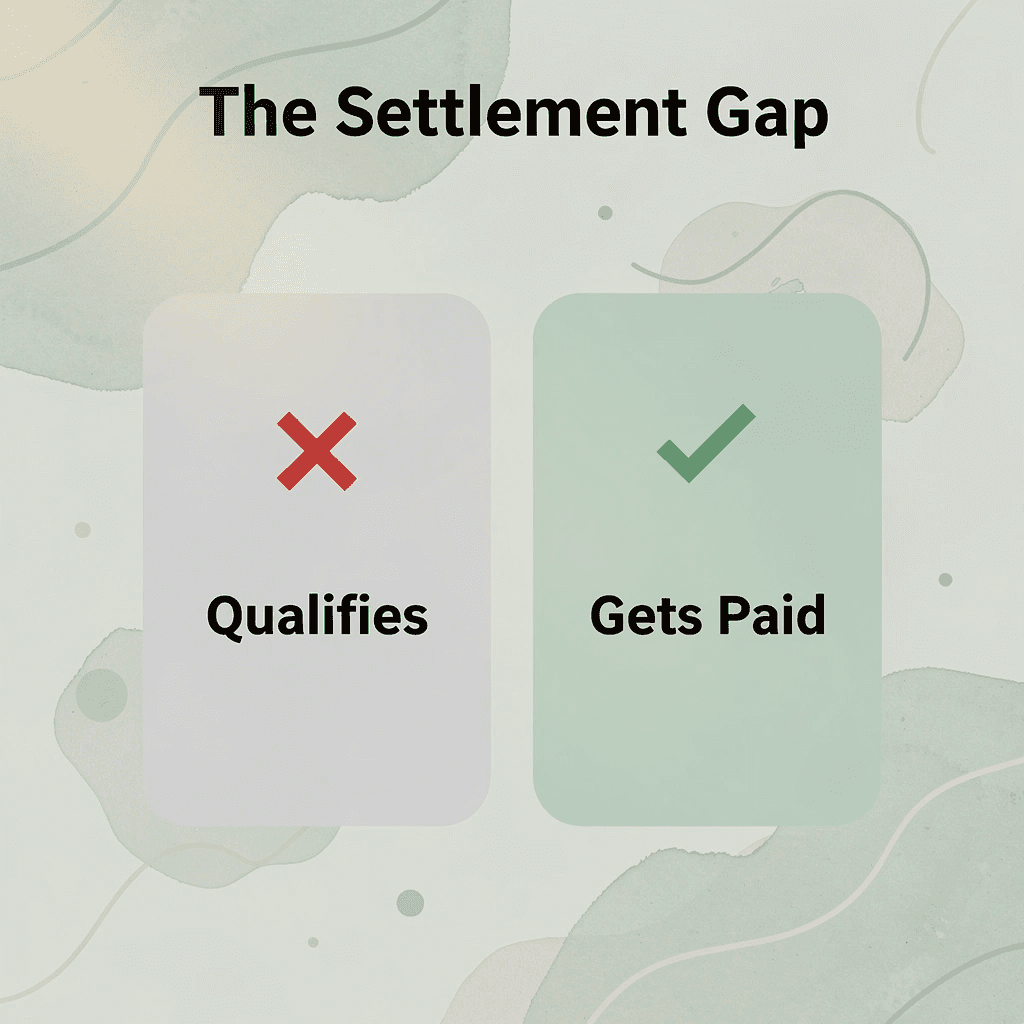
Closing the gap between who qualifies for money and who actually gets paid is a logistics problem. Most people who qualify for settlements like the Google Android cellular data case never file because the process feels unclear, takes considerable time, or they don’t know about it. Sparrow was built to solve that sequence of failures.
“Most people who qualify for settlements never file — not because they’re ineligible, but because the process gets in the way.” — The Core Problem Sparrow Solves
💡 Tip: If you’ve owned an Android device and used cellular data, you likely qualify for settlement money you’ve never claimed — and Sparrow makes finding out take minutes, not hours.
🎯 Key Point: Sparrow was designed to eliminate the three biggest barriers to claiming settlement money: lack of awareness, confusing processes, and wasted time — so qualifying users actually get paid.
Why do most people miss the Google Android cellular data lawsuit deadline?
The most common breakdown point is discovery. Class action settlement notices get buried in email spam folders, printed in fine-print legal journals, or posted on court websites that few visit. By the time a consumer hears about a qualifying claim through word of mouth, the filing deadline has often passed. Sparrow monitors active settlements continuously and matches them to your profile automatically, so relevant claims surface to you rather than requiring you to find them.
How does Sparrow simplify the claim filing process?
Most people handle claim forms by finding the PDF, reading through pages of legal language, filling in their details by hand, and hoping they submitted correctly before the deadline. When the form is confusing or the deadline feels far away, many filers abandon the process entirely. Sparrow pre-fills your information and handles physical mailing when needed, covering postage. What once took an hour of careful attention now takes minutes, and the submission reaches the claims administrator without the errors that typically cause rejections.
What other types of money can Sparrow help you recover?
The App Store lists Sparrow as tracking five categories of money: class action settlements, unclaimed money, price-match refunds, airline compensation, and subscription overcharges. Consumers rarely qualify for a single claim type. The Google Android data lawsuit exemplifies a broader pattern of corporate data practices that have generated multiple overlapping settlements. A tool catching only one category leaves real money on the table.
How do you track your claim status after filing?
After filing, most claimants enter a waiting period with no visibility into what happens next. Settlement administration can take months, and without a tracking system, it is easy to forget you filed at all. Sparrow keeps a live record of every submitted claim, notifies you of status changes, and flags when payments are issued. According to the App Store, Sparrow holds a 4.2 out of 5 star rating from 122 reviews, reflecting users’ finding real, repeatable value. The money from the Google Android settlement already exists and has been court-approved. Your share is waiting. The only variable left is whether you claim it before the window closes.
Related Reading
- Poppi Lawsuit
- Is Settlemate Legit
- Rocket Money
- Celsius Lawsuit
- Claim App
- Fortnite Lawsuit
- Is Claimmoney.com Legit
- Catch
- Truebill
- At&t Lawsuit
- Settlemate
Start Finding Money You May Be Owed with Sparrow
Sparrow closes the gap between knowing about settlements and actually filing claims. Our platform surfaces active settlements you qualify for, pre-fills eligible claim forms, and tracks submissions after you file. Members typically access more than 90 active settlements and recover an average of over $345 annually, backed by a money-back guarantee if your recovery does not exceed your membership cost in the first year.
“Members typically access more than 90 active settlements and recover an average of over $345 annually, backed by a money-back guarantee.” — Sparrow
| What Sparrow Does | What You Get |
|---|---|
| Surfaces active settlements you qualify for | Access to 90+ live claims |
| Pre-fills eligible claim forms | Zero manual research required |
| Track submissions after you file | Full visibility into your recovery |
| Money-back guarantee | Risk-free first year |
💡 Tip: Don’t leave money on the table — most people never file for settlements they’re already entitled to simply because they don’t know where to look.
🎯 Key Point: Sparrow members recover an average of over $345 per year by accessing 90+ active settlements — all with a money-back guarantee protecting your investment.


Leave a Reply