


When companies overcharge, mislead, or sell defective products, the law allows affected consumers to band together and recover money through a class action lawsuit. Most people never collect simply because they do not know a settlement exists or find the process too time-consuming to bother with.
Several apps and services now aim to solve that problem, but they vary widely in cost, coverage, and ease of use. Sparrow stands out as a free option that scans settlements on your behalf and matches them to your actual purchases, making it straightforward to join class action lawsuits.
Table of Contents
- What Is Catch, and What Does It Offer?
- Why Do Users Look for Catch Alternatives?
- Which Features Matter Most When Comparing Class Action Claims Platforms?
- 9 Best Catch Alternatives for Class Action Claims in 2026
- Key Factors to Consider Before Choosing a Catch Alternative
- Why Consumers Trust Sparrow to Find and Claim Unclaimed Class Action Settlements
- Start Finding Money You May Be Owed with Sparrow
Summary
- Class action settlements go uncollected not because consumers are ineligible, but because they never hear about them in time. The discovery process has historically relied on buried legal notices, forwarded emails, or chance encounters with news articles. By the time most people learn a settlement exists, the filing window is already narrowing or closed entirely.
- Administrative friction, not ineligibility, is the primary reason claim rates stay so low. The FTC found that median claims rates in consumer settlements studied are just 9%, with documentation requirements and multi-step external filing processes driving most of the gap. A settlement requiring original receipts from three years ago is functionally inaccessible for the majority of people who would otherwise qualify.
- Early onboarding friction determines whether users ever file a single claim. Research from Quettra, analyzed by Andrew Chen, shows that the average app loses 77% of its daily active users within the first three days after install, often because a single moment of uncertainty at a critical step ends the relationship permanently. For settlement platforms, that moment typically arrives at the bank connection screen, where the perceived risk of sharing financial access outweighs the potential payout for the user.
- Database quality matters more than database size when it comes to actual filing behavior. A curated set of 60 to 97 active, well-matched claims consistently produces better outcomes than an unfiltered archive of thousands of claims, because decision fatigue stops most people before they complete a single form. Relevant and current beats comprehensive and cluttered in every meaningful measure of user engagement.
- Tracking and status communication are not optional features. They are the mechanisms that keep a claim alive across the 6- to 12-month (sometimes longer) administrative timelines that separate submission from payout. Cornerstone Research’s analysis of securities class actions from 2015 through 2024 shows how prolonged resolution periods erode participation when users lose visibility into the status of their claims. Silence reads as failure, and people quietly stop filing new claims as a result.
- Average users who consistently file across multiple eligible settlements recover over $345 per year, a figure that only holds when the platform catches claims before deadlines pass rather than surfacing them after the window closes. The gap between what consumers qualify for and what they actually receive is not a legal problem. It is a timing and process problem, and it closes when discovery and filing happen in the same place without friction in between.
- Sparrow addresses this by running weekly scans for no-proof-required settlements, pre-filling claim forms, and tracking submission status in a single dashboard, so the connection between eligibility and payout remains intact throughout the full timeline.
What Is Catch, and What Does It Offer?
Catch is a free app that scans your transaction history, matches you to active class action settlements, and walks you through filing a claim without a lawyer. It turns a process that used to require hours of legal research into something you can complete in a few taps.
💡 What It Does: Catch handles the entire process — from scanning your transactions to matching eligible settlements — so you never need to hire a lawyer or do your own legal digging.
“Catch turns a process that used to require hours of legal research into something you can complete in a few taps.” — Core Value Proposition
🎯 Key Point: Catch is completely free to use, making it one of the most accessible tools available for everyday consumers who want to claim money they’re already owed.
| Feature | Without Catch | With Catch |
|---|---|---|
| Finding settlements | Manual research, hours of searching | Automatic matching to your transactions |
| Filing a claim | Complex legal forms, lawyer fees | Guided process in a few taps |
| Cost | Potentially hundreds in legal fees | Free |
| Time required | Hours of research | Minutes per claim |

How does Catch automatically match you to settlements?
Here’s how it works: connect your bank or spending accounts, and Sparrow checks your purchase history against official settlement databases. When a match appears—such as a Snapchat settlement worth up to $300 or a Temu case with possible payouts of up to $450—the app displays case details, required submissions, and deadlines. Many settlements require zero proof of purchase, eliminating the primary barrier that prevents most people from filing.
Why does Catch replace the old luck-based discovery system?
Most discovery happens through buried legal notices or forwarded emails: a passive, luck-dependent system. Sparrow replaces it with active, personalized matching. Your spending history becomes the filter, not your ability to stumble across the right news article at the right time. Most people assume someone else is keeping track of settlements, costing them real money. Sparrow scans settlements on your behalf and flags those tied to your actual purchases, shifting the barrier from “finding the right case” to “pressing submit”. Check out our platform to see how we automatically match you with cases.
What the payout timeline actually looks like
Filing a claim through Catch starts the payout process. Payouts typically arrive 6 to 12 months after submission, sometimes longer depending on class size and appeals. The settlements Sparrow finds are normal opportunities that go unclaimed because nobody flagged them in time. The money is already there. The question is whether you will show up before the deadline closes.
Why Do Users Look for Catch Alternatives?
Showing up before the deadline matters. But what happens when the platform meant to help you get there keeps getting in the way?
“The best tool is the one that works with you, not the one that creates new obstacles between you and your goal.” — UX Research Principle
🎯 Key Point: When a freelance platform causes more friction than it removes, users will search for better alternatives.
⚠️ Warning: Staying loyal to a broken workflow out of habit costs you real time, real clients, and real income — the very things the platform was supposed to protect.

| Common Reasons to Seek Alternatives | Impact on Users |
|---|---|
| Platform friction | Slows down critical deadline prep |
| Poor user experience | Increases stress and errors |
| Lack of reliability | Erodes trust and productivity |
What friction inside Catch pushes users toward other tools?
The most common reason users look elsewhere is friction inside the tool itself. When a bank connection step triggers fear of unauthorized charges, when a claim marked “no proof needed” requests documentation, or when a submitted file disappears with no confirmation number or status update, the app stops feeling like a shortcut and becomes an obstacle.
The failure point is usually trust, not technology. A user hesitating at the Plaid login screen makes a reasonable calculation: the potential payout does not feel worth the perceived risk of granting financial access to an unfamiliar app. According to Andrew Chen’s analysis of Quettra data, the average app loses 77% of its daily active users within the first three days after installation. One moment of uncertainty at a critical step often ends the relationship permanently.
How does poor communication cause users to abandon Catch?
When six months pass with no communication and no visible progress, the filing fades entirely from memory. Platforms like Sparrow that join class action lawsuits on your behalf while maintaining clear, ongoing status communication keep the relationship alive long enough for the payout to arrive.
What happens when Catch sets the wrong expectations on a claim?
The difference between what the app promises and what the claims process requires creates lasting frustration. When a settlement is listed as needing no documentation but an administrator requests receipts anyway, users blame the platform for misaligned expectations. This mismatch worsens when our in-app tracking system fails to log submissions properly, forcing users to restart filings they’ve already completed. Wasted effort on time-sensitive claims drives users to compare alternatives in the app store.
Why does unreliability make users search for Catch alternatives?
Users are not asking for perfection; they are asking for reliability. When customer support channels are unclear and technical glitches go unresolved, the platform stops feeling like an advocate. A sparse settlement database amplifies this: if claims worth filing are not surfaced consistently, the value proposition collapses. According to Semrush’s analysis of Google search behavior, 15% of all Google searches each day are queries that have never been seen before, reflecting active searches for solutions to unmet needs. The search for Catch alternatives is part of that same behavior.
Related Reading
- What Is A Class Action Lawsuit
- What Is A Class Action Settlement
- How Do Class Action Settlements Work
- How To Find Unclaimed Money
- Are Class Action Settlements Taxable
- Doge Transparency FOIA Lawsuit
- General Motors V8 Engine Lawsuit
- Shannon Sharpe Lawsuit
- Google Android Cellular Data Lawsuit
- Pima County Sheriff Lawsuit
- Ozempic Lawsuit
Which Features Matter Most When Comparing Class Action Claims Platforms?
The features that separate useful platforms from forgettable ones determine whether eligible consumers actually collect money or simply browse a list and move on.
“The difference between a great claims platform and a mediocre one isn’t just aesthetics — it’s whether real people walk away with real compensation.” — Industry Insight
🎯 Key Point: Not all class action claims platforms are created equal — the right features can mean the difference between collecting your compensation and missing out entirely.
| Feature | Why It Matters | Impact on Users |
|---|---|---|
| Eligibility Matching | Automatically identifies relevant claims | Higher claim rates |
| Deadline Tracking | Prevents missed filing windows | No lost payouts |
| Simple Submission Flow | Reduces friction for claimants | More completions |
| Claim Status Updates | Keeps users informed throughout | Better trust & retention |
💡 Tip: When evaluating a platform, always prioritize automated eligibility detection and deadline alerts — these two features alone dramatically increase your chances of successfully collecting compensation.
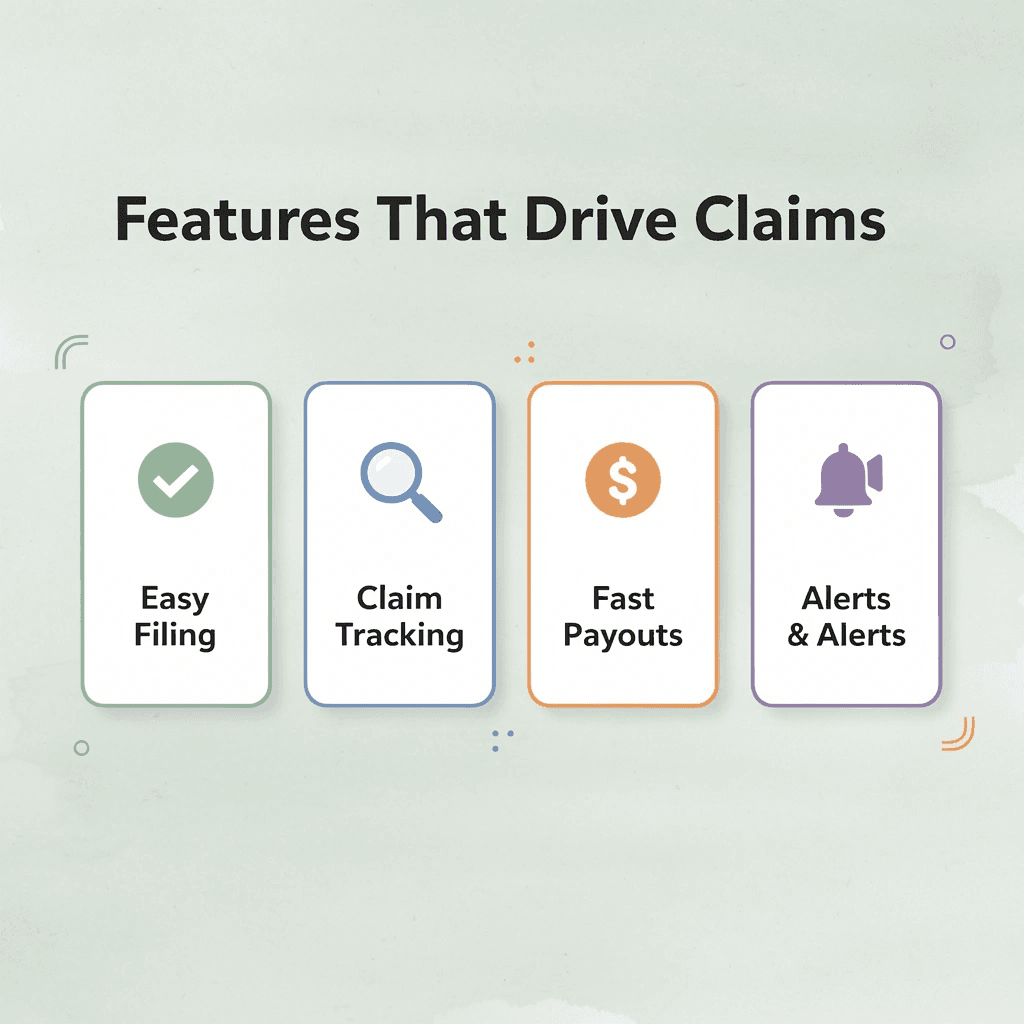
Database quality beats database size
A platform showing 1,000 settlements sounds impressive until you filter out expired claims, irrelevant industries, and cases that require documentation you cannot meet. A curated database of 60 to 97 active, well-matched claims consistently produces better filing rates than an unfiltered archive. Relevant beats comprehensive, every time.
Why in-app filing changes the math
The drop-off between “I found a settlement I qualify for” and “I submitted a claim” is where most platforms lose their users. Redirects to external sites require new logins, repeated data entry, and forms that assume prior knowledge. According to the FTC’s retrospective analysis of class action settlements, median claims rates in the settlements studied are 9%, with administrative friction as a primary driver. Platforms that handle in-app submissions with pre-filled fields and electronic signatures treat that friction as a problem worth solving.
Most people bookmark settlement pages intending to return later, but that intention rarely survives the week. Platforms like Sparrow address this by combining settlement discovery with in-app filing, so the moment a user confirms eligibility, submission is within reach and paperwork is handled automatically.
The proof burden problem nobody talks about
Proof requirements kill participation. A settlement demanding original receipts from three years ago is functionally inaccessible to most people, regardless of a claim’s legitimacy. Platforms surfacing no-proof or minimal-documentation claims first aren’t cutting corners—they recognize settlement money is already allocated, and the only question is whether it reaches consumers or stays uncollected. Accurate eligibility matching based on purchase behavior or account history converts vague potential into submitted claims, which is the only version that counts.
Tracking and payout speed are not optional features
Settlement timelines extend across months or years. Cornerstone Research’s analysis of approved claims rates in securities class actions from 2015 through 2024 shows how extended resolution periods reduce participation when users lose track of their claims. Deadline alerts, status updates, and electronic disbursements keep claims active throughout processing. A platform without proactive tracking asks users to maintain focus through inevitable life interruptions.
How does Catch close the loop on security and interface design?
Security and interface design complete the picture. Sharing purchase history or financial data requires trust, and clunky designs or opaque practices destroy it quickly. Once a platform earns trust through encryption, clarity, and ease of use, the consumer shifts from passive bystander to active participant who shows up and gets paid.
Related Reading
- Nightfall Group Lawsuit
- Gmail Class Action Lawsuit
- Temu Lawsuit
- Apple Class Action Lawsuit
- Hexclad Lawsuit
- Isotonix Lawsuit
- Amazon Prime FTC Settlement Lawsuit
- Capital One Class Action Lawsuit
- Dapper Development Lawsuit
- Life360 Lawsuit
- Minnesota Ice Lawsuit
- Amazon Fire TV Stick Lawsuit
- Costco Sonoma County Lawsuit
- Turbotax Lawsuit
- AT&T Class Action Lawsuit
9 Best Catch Alternatives for Class Action Claims in 2026
Class action settlement apps work in fundamentally different ways. Some focus only on active lawsuits, while others recover money from multiple sources, automate filing, or provide better claim tracking. These alternatives address different needs that Catch may not fully meet, with strengths, limitations, and improvements tailored to different user types.
“Not all class action platforms are created equal — the right alternative depends on whether you prioritize automated filing, multi-source recovery, or real-time claim tracking.” — Class Action Settlement Industry Overview
🎯 Key Point: The best Catch alternative for you depends on your specific needs — whether that’s passive automation, maximum claim coverage, or transparent tracking dashboards.
| Feature Focus | Best For | Key Advantage |
|---|---|---|
| Active Lawsuit Tracking | Users monitoring ongoing cases | Real-time status updates |
| Multi-Source Recovery | Users maximizing payouts | Broader claim eligibility |
| Automated Filing | Hands-off users | Zero manual effort |
| Claim Tracking Tools | Detail-oriented filers | Full visibility and control |
💡 Tip: Before choosing a Catch alternative, identify your primary pain point — missed deadlines, low recovery amounts, or lack of filing transparency — to match the right platform to your needs.

1. Sparrow
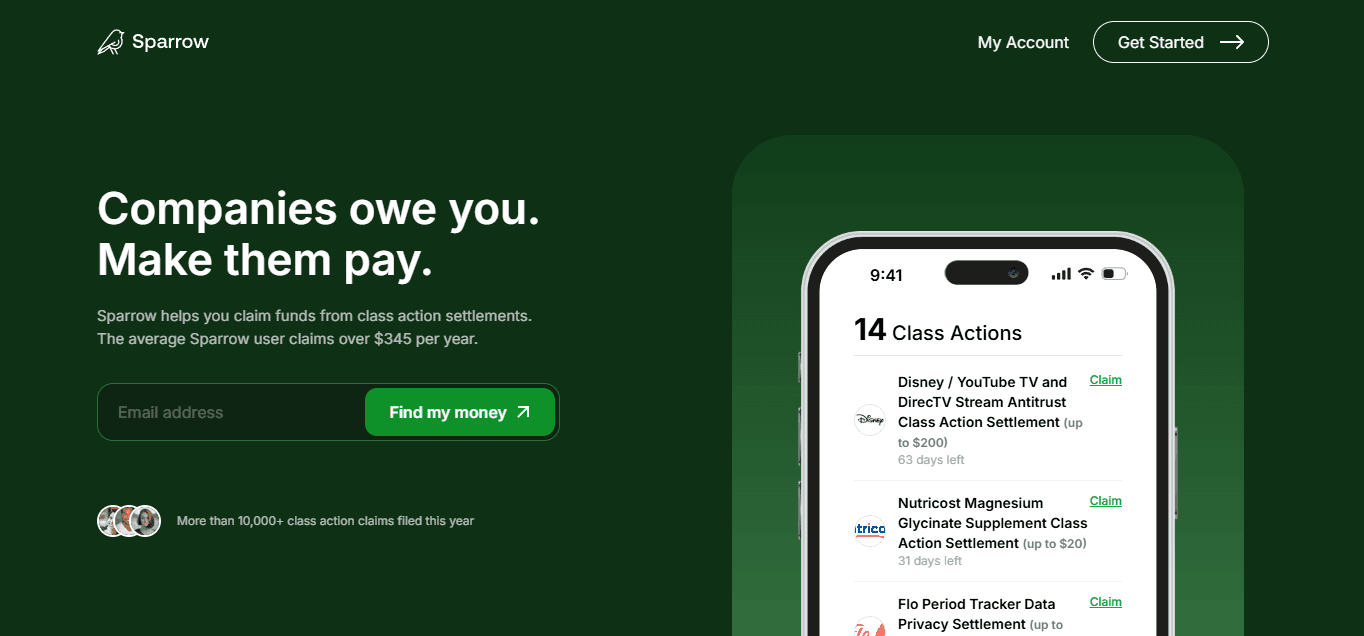
Sparrow is an easy-to-use class action discovery platform that searches for eligible settlements, fills in claim forms, and mails them for you with a money-back guarantee. It solves Catch’s problems by eliminating the need for bank logins, focusing on claims that don’t require proof, providing clear tracking with mailed confirmations, and offering reliable support through a simple subscription model.
Key Features
- Weekly No-Proof Claims Delivery: Sparrow emails new settlements that don’t require proof each week, addressing Catch’s limited database and proof mismatch problems.
- Pre-Filled and Mailed Claim Forms: Our platform completes forms and pays for postage, solving Catch’s broken browser flows and manual tracking issues.
- Money-Back Guarantee: If you don’t recover more than your subscription cost in the first year, Sparrow refunds the difference, building trust beyond Catch’s uncertain payouts.
- Centralized Claim Dashboard: Users access a clear overview of filed claims with status visibility, addressing Catch’s issues with locating claim numbers and pins.
- High-Value Settlement Focus: Highlights cases with payouts of $10,000 or more (such as Comcast Xfinity), offering stronger recovery potential than many Catch matches.
- No Bank Account Connection Required: eligibility is determined by simple profile details rather than by sharing transaction history, resolving security and hidden fee concerns.
- Perjury-Compliant Guidance: Clear instructions ensure accurate submissions under penalty of perjury, reducing the risk of rejection.
- Multi-Claim Filing: File multiple claims in minutes with Sparrow, saving significantly more time than Catch’s fragmented process.
- Dedicated Settlement Monitoring: Our continuous scanning for new lawsuits provides broader and more consistent opportunities than Catch’s limited active set.
- Easy Cancellation and Transparency: straightforward subscription management with no hidden fees or lock-ins.
Pros
- Physical mailing service saves significant time and effort.
- A strong money-back guarantee reduces risk.
- Focus on accessible non-proof claims.
- Positive user feedback on speed and simplicity for multiple filings.
- Regular new settlements delivered weekly.
Cons
- Not a law firm; no legal representation provided.
Accessibility
Fully accessible via usesparrow.com. The mobile-responsive design enables easy use on phones, and subscriptions can be managed or canceled at any time.
2. Payout
Payout is a free mobile app that lets you check if you qualify for money from a large database of active settlements. Users file claims directly in the app without connecting their bank accounts, eliminating the security concerns, proof mismatches, and tracking gaps that Catch has.
Key Features
- Self-reported purchase history without access to Plaid bank accounts eliminates login fears.
- In-app claim filing keeps everything in one place and avoids broken browser flows.
- A large, active settlement database with frequent updates reduces complaints about a lack of options.
- Deadline alerts and progress tracking are built in, improving visibility over Catch’s limitations.
- High download volume and ratings that provide social proof and demonstrate active maintenance.
- Focus on consumer brands with clear eligibility questions to minimize proof surprises.
- Completely free core experience with no commissions on payouts.
Pros
- No bank data sharing required.
- Fast filing process in minutes.
- Strong track record with hundreds of thousands of users.
- Transparent settlement list.
Cons
- Relies on user self-reporting, which may miss some matches.
- Payout timelines remain court-dependent.
3. Settlemate
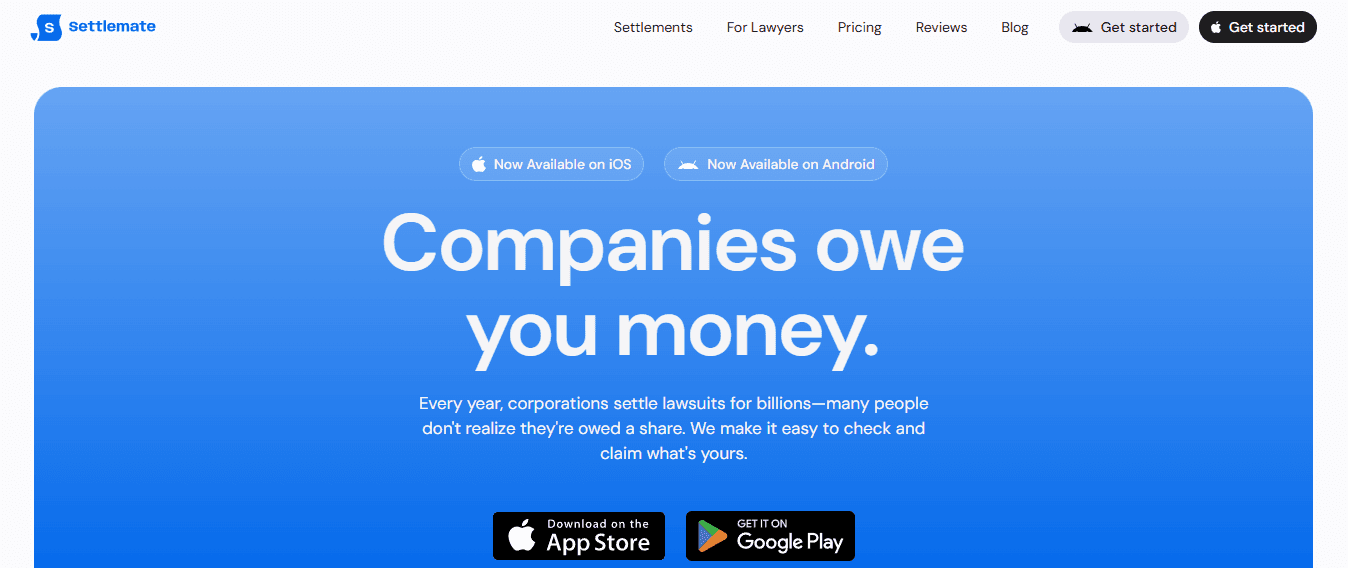
Settlemate is a subscription app that automatically matches users to settlements through questionnaires and supports filing claims in class actions, plus extra savings like price drops. It addresses Catch’s tracking issues with better status monitoring, broader recovery tools, and reduced manual paperwork.
Key Features
- Questionnaire-based matching without full access to bank transactions for greater privacy.
- Comprehensive claim status tracking and payout timeline estimates.
- Extra tools for refunds and overcharges beyond class actions.
- In-app or guided filing that minimizes problems with external site navigation.
- Regular database updates focusing on product defects for high-value cases.
- Provide clear eligibility details to avoid proof-requirement surprises.
- Dedicated support channels for subscription users.
Pros
- Broader money recovery features and automated matching convenience.
- Professional interface with good ratings.
Cons
- Subscription fee required.
- May redirect for some filings.
- Newer compared to established options.
4. TopClassActions
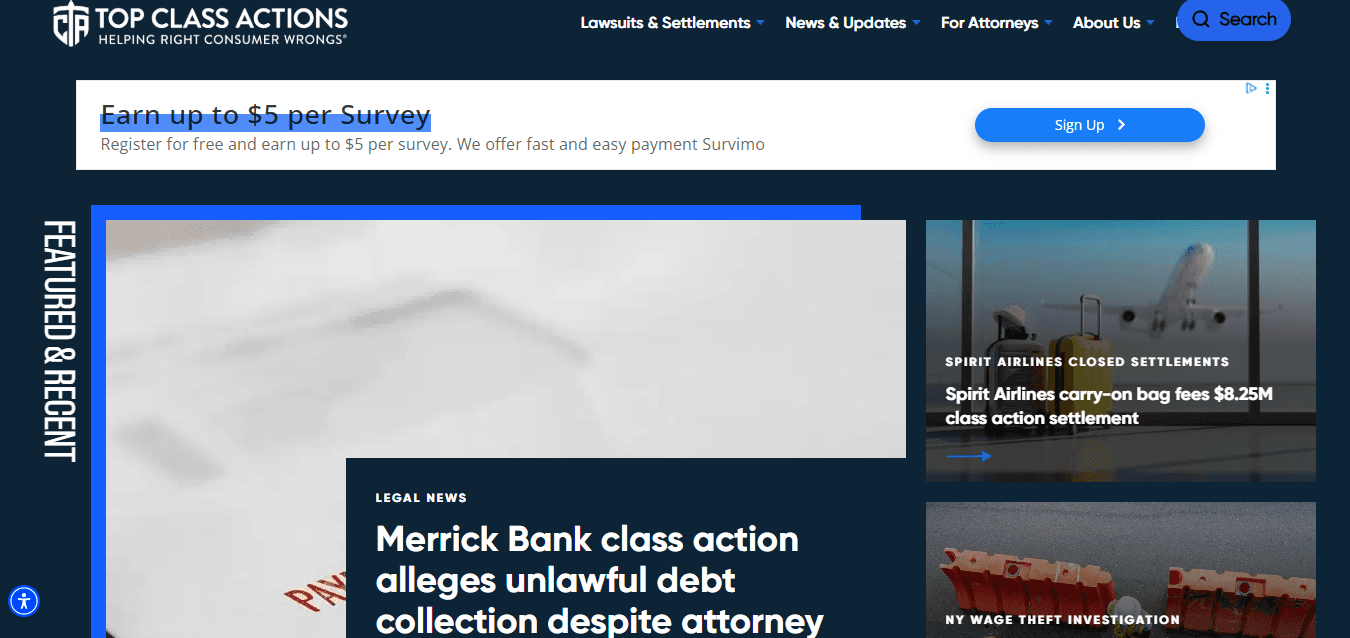
TopClassActions is a comprehensive website and newsletter hub that lists open settlements, with direct links to file. It solves Catch’s problems by offering a large, searchable database that updates daily and sends regular case updates.
Key Features
- Large, searchable database of open settlements updated daily with direct links to official claim forms and administrators.
- Free newsletter for deadline and payout alerts.
- No app login or bank requirements.
- Detailed case descriptions require upfront proof.
- Covers both settlements and ongoing lawsuits for early awareness.
- Long-established reputation since 2008.
Pros
- Completely free to browse and use.
- Excellent for research and news.
- Transparent official sources.
- Covers a wide range of cases.
Cons
- More manual filing process with no automated pre-filling.
- Website-based rather than a full app experience.
5. ClassAction.org
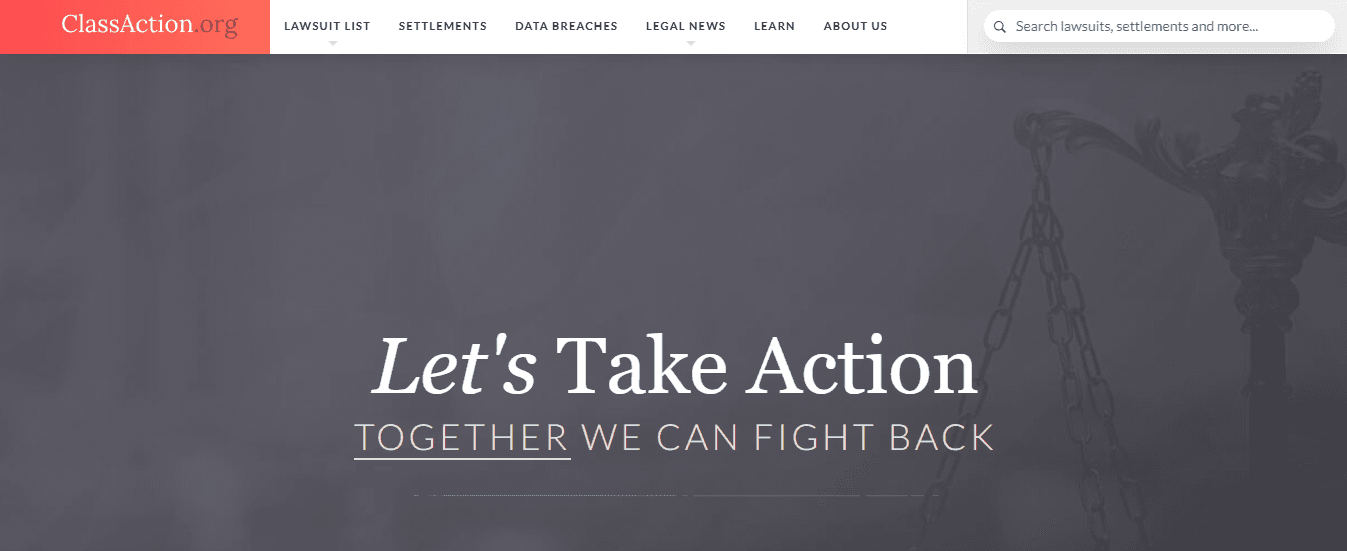
ClassAction.org is a free, ad-free database of verified open settlements, rebates, and claim tools that addresses trust gaps through independent listings, direct links to administrators, and educational resources.
Key Features
- Curated verified settlements with no-proof options highlighted.
- Free access to full claim details, deadlines, and official sites.
- Educational tools and news on class action processes.
- No account, subscription, or bank information required.
- Regular updates on payouts and new cases.
Pros
- 100% free and trustworthy.
- Strong educational content and direct links to official filings.
- Broad case coverage.
Cons
- Requires manual navigation for filing.
- No automated matching or form pre-filling.
6. Collect
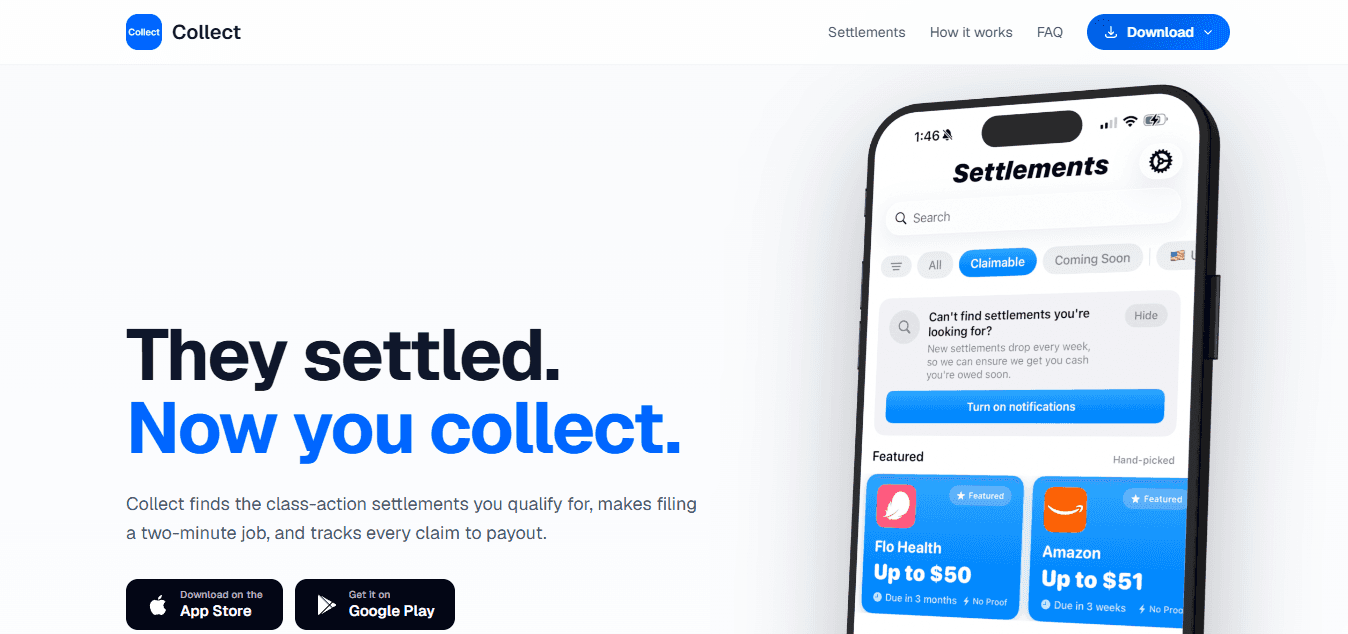
Collect offers a mobile app that lets you browse hundreds of active settlements, file claims, and track your payment progress. It addresses Catch’s shortcomings by providing an intuitive interface, deadline filters, and end-to-end visibility without requiring a bank account connection.
Key Features
- Hundreds of settlements you can browse and filter directly
- File claims in the app to keep things simple and organized
- Track your progress from submission to expected payment
- No bank connection needed—report information yourself or search for cases
- Deadline filters and alerts to prevent missed opportunities
- Clean, modern design focused on speed and clarity
- Cases that don’t require proof when possible, making qualification easier
Pros
- Large selection of active cases
- Strong tracking capabilities
- Easy-to-use mobile experience
- Free core features
Cons
- May involve some manual steps
- Payouts follow standard timelines
- Less automation in matching than in options that connect to your bank
7. ClaimDepot
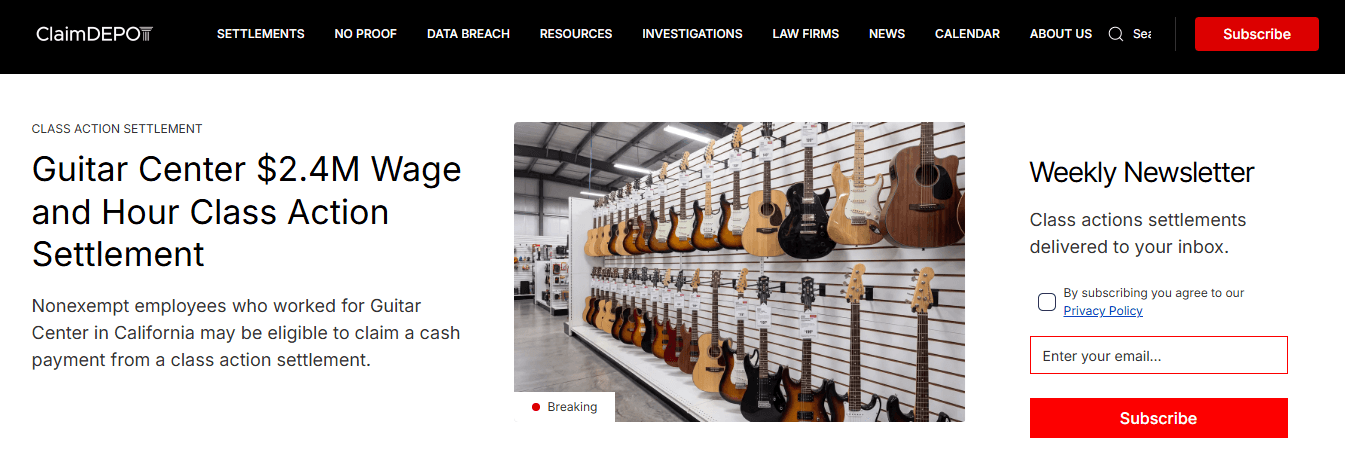
ClaimDepot maintains a searchable database of settlements, including no-proof settlements and open settlements, with advanced filters, sorting, and direct filing guidance. It provides transparent, independent listings that clarify what you need to prove and better organize ongoing claims.
Key Features
- Advanced search, filter, and sort tools for hundreds of settlements with clear indicators for cases that don’t require upfront proof.
- Weekly newsletter for new opportunities and deadlines.
- Direct links to official claim portals with no login or financial data sharing required.
- Focus on verified, active claims with easy organization of settlements you are following.
Pros
Powerful search functionality, free access to a comprehensive database, regular email updates, and transparent proof requirements.
Cons
Website-based with filing that often directs to external sites and less support than full-service apps.
8. MoneyPilot
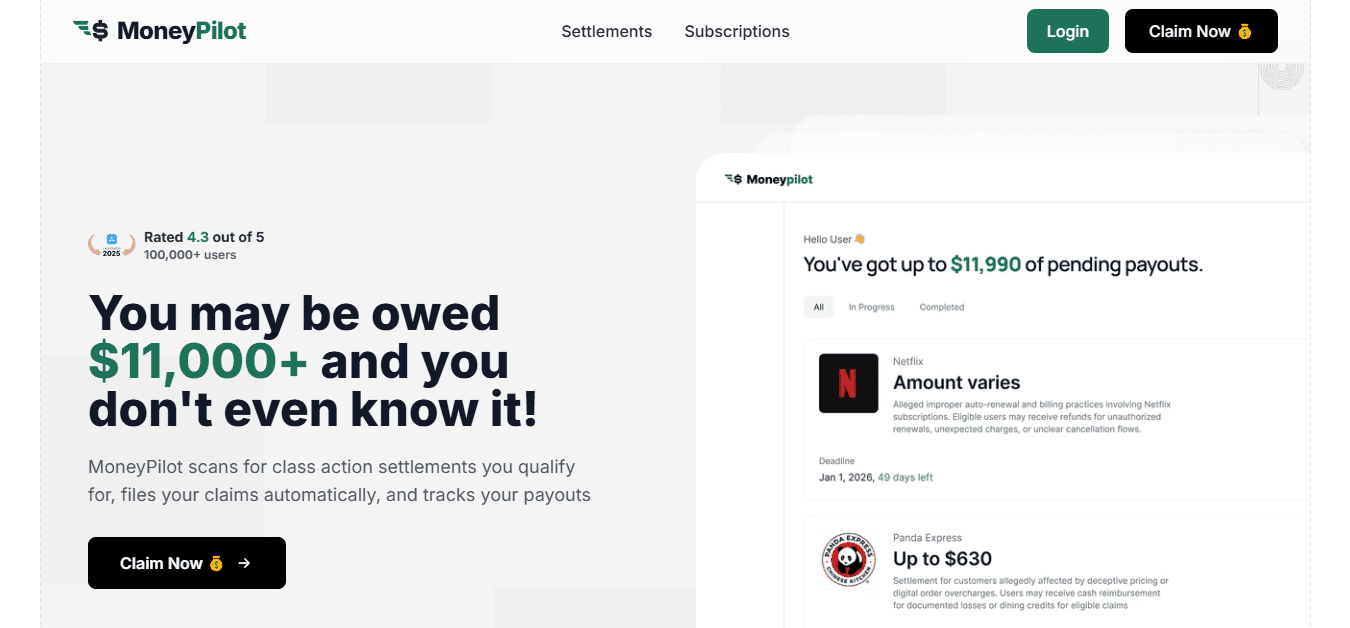
MoneyPilot combines class action settlement finding with broader financial recovery tools, including subscription management. It addresses Catch’s limited scope by offering integrated tracking, automated features, and multi-purpose savings that deliver consistent value.
Key Features
- Unified platform for settlements, subscription refunds, and overcharges with automated matching and claim assistance.
- Comprehensive financial recovery beyond class actions, reduced bank login requirements, and improved tracking and notifications across all claims.
- Subscription model with clear value and easy cancellation, focused on maximizing total annual recoveries.
Pros
- Broader money-saving tools.
- Strong automation and tracking.
- All-in-one financial dashboard.
- Reliable for multiple recovery types.
Cons
- Subscription-based pricing.
- Newer in the combined space.
- May require some setup for full features.
9. Consumer-Action.org
Free consumer advocacy sites like Consumer-Action.org provide open settlement databases, guides, and direct resources for filing without fees or app barriers. They address Catch’s trust issues, fees, and technical glitches by delivering independent, no-cost information and direct links to administrators.
Key Features
- Completely free, no-subscription databases of open claims.
- Educational guides that clarify processes and reduce confusion.
- Direct access to official settlement websites and forms.
- No accounts, banks, or downloads required.
- Focus on verified consumer rights cases.
- Regular updates on new and paying settlements.
- Independent advocacy ensures unbiased listings.
Pros
- Zero cost and high transparency.
- Excellent educational resources.
- Direct official pathways.
- No technical app issues.
Cons
- More manual research and filing.
- Less automated matching.
- Website-focused experience.
Key Factors to Consider Before Choosing a Catch Alternative
The best alternative should help you find real opportunities, make filing easier, keep your personal information safe, and keep you updated until you get paid.
“The right platform doesn’t just replace Catch — it actively works to protect your data, streamline your filing, and surface opportunities you’d otherwise miss.” — Industry Best Practice
🎯 Key Point: Not all alternatives are created equal — the best options deliver on four critical pillars: opportunity discovery, simplified filing, data security, and real-time payment updates.
| Factor | Why It Matters |
|---|---|
| Real Opportunities | Ensures you’re actually finding work, not just browsing listings |
| Easier Filing | Reduces time and errors in the submission process |
| Personal Data Safety | Protects your sensitive information from breaches or misuse |
| Payment Updates | Keeps you informed in real time so you’re never left guessing |
💡 Tip: Before committing to any Catch alternative, always verify that it meets all four criteria — a platform strong in one area but weak in data security or payment transparency is not a complete solution.

Cost Structure and Value
Look at whether the platform charges subscriptions, takes percentages of payouts, or operates for free. Free options eliminate upfront costs but may limit automation or database size, while paid services justify fees through pre-filling, mailing, guarantees, or broader recovery tools. Calculate potential annual recoveries against fees—platforms with money-back guarantees ensure you recoup costs if results fall short. Always confirm you keep 100% of administrator-issued payouts.
Privacy and Data Security
Choose platforms that limit connections to your bank account through Plaid or similar services. Self-reporting or questionnaire-based matching keeps your financial data safe while providing relevant settlements. Read privacy policies to understand how data is handled, and prefer tools that don’t request sensitive login information.
Number and Quality of Active Settlements
Check the size and freshness of the database. Look for platforms that track dozens to hundreds of verified, court-approved cases with regular updates. Seek diversity in categories such as data breaches, consumer products, and privacy violations. Verify clear details on payout ranges and deadlines. A larger, actively maintained selection increases your chances of qualifying.
Filing Process and Automation Level
Consider how much hands-on work the platform requires compared to full automation. Top alternatives let you fill in forms ahead of time, send submissions by mail, or guide you through filing in the app to reduce manual work and trips to external websites. Features like deadline reminders and status dashboards help you track progress, while high levels of automation save hours compared to basic listing sites that only link to forms.
Claim Tracking and Support
Good alternatives provide real-time dashboards, notifications, and easy access to claim details, including claim numbers and status updates. Look for customer support channels that work well and educational resources that explain processes clearly. Reliable tracking prevents forgotten filings, while accessible help ensures you can solve problems quickly.
User Reviews and Proven Track Record
Look at independent ratings, download numbers, and genuine testimonials focusing on actual recoveries and ease of use. Platforms with hundreds of thousands of users and consistent positive feedback about payouts demonstrate reliability. Read comments about real results, support experiences, and long-term value rather than relying solely on star ratings.
Additional Recovery Features
Look for tools that go beyond class actions to include price drops, subscription refunds, and travel compensation. Broader capabilities help you save more money and address multiple spending issues.
Ease of Use and Accessibility
Pick easy-to-use interfaces that work on mobile apps or responsive websites. Options that don’t require proof, offer simple sign-up processes, and allow multiple claims streamline the experience. Test navigation ease and mobile functionality to ensure the tool integrates smoothly into your daily routine.
Why Consumers Trust Sparrow to Find and Claim Unclaimed Class Action Settlements
People trust Sparrow because it removes the two big problems that stop most people from getting settlements: not knowing a settlement exists and not finishing the paperwork. Trust is built through a system that catches what you would otherwise miss and handles what you would otherwise quit.
“The two biggest barriers to claiming settlements are awareness and follow-through — Sparrow eliminates both.“
| Barrier | Why It Stops Most People | How Sparrow Solves It |
|---|---|---|
| Not knowing a settlement exists | Settlements are rarely advertised to eligible claimants | Automatically monitors and matches you to open claims |
| Not finishing the paperwork | Forms are tedious, confusing, and easy to abandon | Handles the filing process so you don’t have to quit |
🎯 Key Point: Sparrow’s value isn’t just finding settlements — it’s making sure you actually collect the money you’re owed.
💡 Tip: If you’ve ever ignored a class action notice or abandoned a claim form halfway through, Sparrow was built specifically for you.
⚠️ Warning: Most people leave settlement money unclaimed not because they’re ineligible — but because the process is designed to make you give up. Sparrow exists to close that gap.
What makes discovery feel reliable?
The main problem with settlement discovery is timing. By the time a consumer hears about a case through a news article or a friend, the filing deadline approaches.
How does Sparrow catch settlements before they expire?
Sparrow runs weekly scans to find high-value settlements that don’t require proof before expiration. The platform delivers cases like Flo Period Tracker privacy payouts up to $700 directly to users without requiring search effort. According to DC News Now via Facebook, a post about Sparrow reached over 1,000 views, indicating consumer interest in unclaimed settlement money.
What happens when the familiar approach causes you to miss your window?
The familiar approach is to bookmark a settlement page, plan to file later, and then lose track entirely. Platforms like Sparrow address this by pre-filling claim forms, covering postage, and tracking submission status in one dashboard, compressing what used to take hours of printing and cross-referencing into a single session.
Why does the money-back guarantee matter?
It makes sense to be skeptical: settlement amounts vary, timelines span many months, and consumers cannot know ahead of time whether a subscription service will deliver value. Sparrow’s guarantee closes that gap—if users don’t recover more than the subscription cost in the first year, they get a refund. That structure demonstrates the platform’s confidence in its results.
How does Catch keep users connected to their claims?
Centralized tracking, status updates, and clear next steps keep users connected to their claims rather than filing once and hoping for the best. Average users recover over $345 per year, a figure that holds only if the platform consistently captures multiple eligible settlements, not just occasional high-profile cases.
What question changes everything about unclaimed money?
The question most people never ask is the one that changes everything: how much money was already sitting there, waiting to be claimed.
Start Finding Money You May Be Owed with Sparrow
The money was always there. Most people never collected it because the process was designed to outlast their patience. That gap between what you qualify for and what you actually receive closes when discovery and filing happen in the same place, without friction.
“The gap between what you qualify for and what you actually receive closes when discovery and filing happen in the same place, without friction.”
💡 Tip: If you’ve bought a product, used a service, or been part of a data breach, unclaimed settlement money may be waiting for you.
Join class action lawsuits with Sparrow, and that shift becomes immediate. Weekly scans catch eligible no-proof settlements before deadlines pass, pre-filled forms handle the paperwork, and a centralized dashboard keeps every claim visible from submission to check. Users recover over $345 per year on average because our platform nets settlements consistently across multiple cases rather than missing windows.
| Feature | What It Does |
|---|---|
| Weekly Scans | Catches eligible settlements before deadlines pass |
| Pre-Filled Forms | Handles all paperwork automatically |
| Centralized Dashboard | Tracks every claim from submission to check |
| No Bank Login Required | Zero financial risk to get started |
| Money-Back Guarantee | Full refund if Year 1 recovery doesn’t exceed subscription cost |
Visit usesparrow.com now, review open settlements, and start filing. It takes minutes, requires no bank login, and comes backed by a money-back guarantee if your first year does not recover more than the subscription cost.
🎯 Key Point: Sparrow users recover $345+ per year on average — not from one lucky claim, but from consistently catching multiple settlements that most people miss entirely.
⚠️ Warning: Settlement deadlines are hard cutoffs. Missing a filing window means permanently forfeiting money you were already owed — don’t let the process outlast your patience again.
Related Reading
- Celsius Lawsuit
- Poppi Lawsuit
- At&t Lawsuit
- Fortnite Lawsuit

Leave a Reply